


Thingumajig (3DFX) and its demo: an intimate game by Polygon Studio, targeted for the Dreamcast, that SEGA had considered publishing
Developed by Polygon Studio, Thingumajig (3DFX) is part of the preservation effort surrounding Felony Pursuit and the studio’s productions: [Felony Pursuit (Dreamcast): A racing game that couldn’t make its way through the crowded Dreamcast release lineup]
Polygon Studio (PS), a little-known French company at the time, brought together many young talents from various backgrounds in the video game industry. Founded in 1996/1997 by former members of Cryo Entertainment, this young Paris-based development studio was ultimately met with misfortune. None of its major projects made it to store shelves, for various reasons beyond its control. Felony Pursuit (Dreamcast/PC), Burning (Xbox), Mayem (PC), and Thingumajig (Dreamcast/PC) were either cancelled or failed to find a publisher. These works each stood out through their exploration of concepts and gameplay mechanics that were, at the time, only lightly explored or entirely new.
Stéphane Tartelin (real-time 3D artist / textures / animation / visual research): « I feel a lot of nostalgia for this studio and that period. Polygon Studio was made up of a ‘dream team’; all the developers were passionate, highly talented, and focused on original projects. Thingu was truly special. »
Homemade Cover created by Benedikt Scheffer

In the late 1990s—and even today—many acknowledged that video games were becoming increasingly standardized. Most studios relied on the same off-the-shelf 3D engines and imitated successful titles from competitors. How many Mario Kart-like games are there? Creativity was fading, and risk-taking was declining. Small, passionate studios like Polygon—and soon SEGA with its future Dreamcast hits—brought a breath of fresh air to an industry in decline. Thingumajig was one such project!
The Thingumajig 3DFX/Dreamcast Prototype
Going against the grain of what was being done in the genre and breaking established industry rules, Thingumajig brought a breath of fresh air to video games. Even though its development never went beyond the Vertical Slice stage (a small, playable portion of the game close to final quality), it already offered an experience unlike any other—and, above all, had a true soul.
Terry Proto (one of the founders of Polygon Studio): « We really liked it—it was cool, cute, fresh, crazy and visually very trendy. Everyone loved Thingumajig. It was different and quite fun. »
More than 25 years after its cancellation, those who were aware of Thingumajig at the time now agree on the undeniable charm the project possessed.
Thingumajig: A Sense of Wonder
Thingumajig offered ideas that ran counter to expectations by exploring gameplay set in darkness. The developers—eight in total—did not aim to frighten the player, but rather to have them manage and overcome their fear. Their goal was to convey on screen the sense of anxiety inspired by childhood fears. As a result, pure violence—so prevalent over the years—was deliberately set aside. With no offensive or defensive weapons at their disposal, players could rely only on their wits to progress. No one died in Thingu.
It’s worth noting that the team behind Thingu was called Hopland. This is because, at the time of merging with the other members of Polygon Studio, they aimed to retain a degree of independence, following a structure similar to SEGA’s internal studios. This is why the game’s credits also attribute it to Hopland rather than solely to PS (“A Hopland Universe”, as stated in The Trailer).
The Play of Light: Sometimes “I See You,” Sometimes “I Don’t”

It’s a fairly niche and relatively obscure game, featuring an adorable visual style that contrasts with its dark atmosphere. Thingumajig adopts a reinvented version of hide-and-seek for video games. This experimental concept, conceived in the late 1990s, has become very popular today.
The interplay of shadow and light is one of the game’s strongest points. Every reflection on any part of the environment or characters, and every subtle change in lighting, expressed the designers’ desire to give the game a unique atmosphere. A little extra touch that set Thingu apart from other productions of the time!
Terry Proto: « We had put a lot of work into the use of light and shadows, which was very ahead of its time. The children could hide in the darkness—it was all about managing their fears of the monsters. It was a really cool concept. »
Thingumajig is an Action/Adventure game following the exploits of four children aged 8 to 10, each with wildly different and exuberant personalities: Apple, an imaginative African-American girl who invents astonishing machines; Dafoe, a mischievous European boy who struggles to separate fantasy from reality; Mélanie, a serious and introverted European girl; and Wang, an Asian boy passionate about basketball. Together, they embark on outrageous adventures in a peaceful American suburb under siege by an alien invasion.
Iconic movie line…: "I was supposed to be on leave this weekend. But no! I'm dragging your sorry-ass through the burning desert with your dreadlocks stickin' out of my parachute." Do you recognize the reference?


Trouble begins for Apple, the only playable character in the game’s demo, when she experiments with her friends using her latest invention, the THINGUMAJIG. This revolutionary telescope aims to uncover the mysteries of the Moon’s hidden side. The mischievous group has no idea that the light emitted by the massive astrograph’s reflector will attract to Mollen City—a hot spot for watermelons—a band of hostile alien musicians. Surprisingly, this juicy fruit stimulates the proliferation of these extraterrestrial creatures from another galaxy, known as the Moths. An opportunity they cannot resist: conquer Earth and enslave humanity. Suddenly, a flying saucer lands near Apple’s house. Aliens with dreadlocks emerge, determined to colonize the Blue Planet. They seize the THINGUMAJIG and accidentally destroy it while trying to figure out its mechanism. Apple’s telescope shatters into multiple fragments, each kept as a trophy by a high-ranking Moth officer. The group of friends vows to gather the scattered pieces of the telescope to reassemble it and prove the existence of aliens to the adults. Meanwhile, humanity faces a great threat: the Moths aim to reproduce rapidly using watermelons. Fortunately, the young heroes intervene, finding the fruits before the aliens can. Apple, Mélanie, Dafoe, and Wang’s adventure takes them through “The Countryside”, “The Haunted House”, “The Zone” (the industrial district), “The Funfair”, “The Museum”, “The Mall”, and “The Residential Area” (the Vertical Slice level), finally culminating in a spectacular showdown at the Moth lunar base.
Majid Taibi (Co-author of Thingumajig): « When I left Polygon Studio, I was introduced to Spike Lee at a private club in London and was told to tell him about my/our project. He said, ‘Whenever there’s an African-American and a watermelon, it’s a racist sign.’ I wasn’t aware of this at the time; I was 28 years old. We had unknowingly touched on a sensitive topic. »
The deliberately exaggerated proportions of the kids’ heads and their small bodies define the artistic identity of Hopland and PS’s title. The realistic environments, the slightly twisted or angled perspectives of the buildings, and the cartoonish design of Thingu’s characters give it a unique charm. This game feels like it stepped straight out of a Tim Burton film!
Visually, Thingu plays like a cake flavored with The Goonies and tasting of Stand By Me. The Rastafarian aliens, the Moths, evoke the lanky, skeletal extraterrestrials from Independence Day movie. The magic happens in the blink of an eye.
Majid Taibi: « We drew inspiration from what we loved. Some guys were more into South Park, others preferred The Simpsons. I was all about Zemeckis. Some listened to funk, others to rock, and so on… »
It is said that this telescope would be the reason the Moths arrived

The humor and constant winks throughout its story reinforce Thingu’s originality. This comedic touch perfectly complements its Artistic Direction but above all reflects the creators’ boundless imagination and the team’s strong camaraderie. The members explored all sorts of mechanics and game rules while maintaining a clear guiding line; they stirred chaos in the narrative, yet kept it coherent, then would return to a more conventional game as if nothing had happened. Thingumajig parodies video games about otherworldly creatures, much like Mars Attacks! pokes fun at alien invasion films. Hilarious situations follow one another, each unique—here are a few examples:
-
Strumming a banjo or banging on a drum to charm the aliens. And yes—they love good music, especially Sister Sledge’s hit “We Are Family”!
-
Hiding inside tree stumps to evade enemies.
-
Gémoniro, the chief of the Native Americans in the forest level, inspired by Geronimo, the Apache leader.
-
The Moths cannot tell reality from fiction. Based on Earth TV shows, they believe the fictional agents Sculder and Mully truly exist and fiercely protect Washington (Fox Mulder and Dana Scully from The X-Files).
-
Bounty hunter Clean Westwood, nicknamed “La Sang-Su,” draws his inspiration from the actor and his iconic role in the Dollar Trilogy.
-
Garalus Boocer (aka “Cheewy”), the alien ship pilot, is wanted across the galaxy for drunk piloting. Among his claims: causing a traffic jam inside a black hole. A little Star Wars humor in his nickname, perhaps?
-
The entire game’s design revolves around a unique sense of humor that only Hopland could deliver—centered on watermelons. This delightfully absurd concept is explained in detail in the chapter: [Thingumajig and Its Game Rules: The Watermelon Festival]. What an idea!
An angelic face. The Moths better not lay a finger on Apple, or else…

Unlike most film or video game productions tackling Martians, Thingu doesn’t involve eliminating them one by one, but rather avoiding or outsmarting them to escape. The heart of the game lies in adapting to their presence. The goal is to keep a distance so the game returns to normal investigation mode if they chase Apple. Frightened, she must rely solely on her wits to get away.
The funny Aliens, caught in a collective frenzy, will dance wildly near any source of music. Completely absorbed, they ignore Apple, who dashes away—true music lovers at heart. They lose sight of her and move away if she chooses to hide in a trash can or in the shadows. Since the aliens are allergic to water, Apple might even be able to use this natural resource against them (fire hydrants, a water gun, etc.).
Apple thinks she's Tony Hawk. She's getting ready to pull off an ollie
Terry Proto: « The Thingu team loved joking around about funny little details, and I think watermelons were one of them. You could use them to defend yourself and throw them at the aliens (with cool animations) or something like that… »

During exploration of the city—on foot or by skateboard—the camera captures the scene from a 90-degree top-down angle (internally called the God Camera). This provides a wider field of view for navigating the city, shows an overview of the streets traveled, and gives the illusion of endless roads. When the aliens chase the girl, the view switches to a third-person perspective until she loses them (internally called the Panic Camera). This sudden change disorients the player, who loses their bearings. Unable to react normally, they panic and run in all directions before regaining composure and finding an escape route. This clever nuance reinforces the design vision the developers had for Thingumajig. It’s interesting to imagine whether this mechanic would have survived under an editor’s pressure to make the game fully third-person, as in 1998—the year Polygon Studio began development—the trend was full 3D!
The game’s soundtrack draws loose inspiration from prolific film composers such as Danny Elfman, a frequent collaborator of Tim Burton, and Jerry Goldsmith, known for the themes of Gremlins, Total Recall, and Rambo. The tracks for Thingumajig, composed by Romain Gauthier (whose work as a Music Artist can be explored on his website), were created using a Roland D-50 synthesizer, based on artistic concepts and numerous discussions with Majid Taibi, one of the two authors of Thingu alongside Carlos Perona. At this stage, the compositions were just beginning and far from finalized.
Romain Gauthier (composer): « I was very young, 18 or 19, coming from a poor family and didn’t have much equipment, but Majid even lent me his synth. It was magical for me, and I sampled a lot of those sounds for Thingu. I’m really glad I was given the chance. And Majid was amazing with me for that. »
Thingu features an orchestral soundtrack with musical segments that loop and transition dynamically depending on on-screen events. When the player performs a positive action, the rhythm softens; conversely, the theme takes on a tense tone if Moths ambush them. This musical interactivity greatly enhances the cinematic adventure feel—much like a horror movie, the score intensifies every scene in the game.
Majid Taibi putting on a motion-capture suit

Polygon Studio took advantage of motion capture to faithfully reproduce an actor’s movements in the animations of Thingumajig’s characters and enemies. Yet, development had only just begun. This costly technique—a few hours of session could run tens of thousands of Euros/Dollars—became more accessible in the early 2000s, notably with Quantic Dream, and is now a standard in game development. The modeling of many in-game elements was achieved using Lightwave, while Jérôme Lanquetot coded the game’s primary engine, called NECTAR. All signs pointed to a promising future for the ongoing development of Thingu!
Majid Taibi: « I wanted motion capture because we didn’t have any real 3D animators. Stéphane and Philippe were working in 3ds Max, Carlos, Stephen, and I were on LightWave 3D. Everything had to fit onto Jérôme Lanquetot’s Nectar… »
The project team favored the Dreamcast as the target platform due to the similarity of its SDK—a set of tools, libraries, prewritten code, and documentation provided by the console manufacturer—to that of the PC. Additionally, the expertise of Polygon Studio’s employees on computers made SEGA’s latest console a natural choice. The Game Design documents reveal the intention to include at least one mini-game on the Dreamcast’s memory card (VMU), featuring ideas like a Pacman-like game—where the player collects a series of watermelons while avoiding the Moths—or a catch-and-collect game, where watermelons fall from the sky and the player must grab them before they hit the ground.
Feel the rhythm... Cool Runnings! (LightWave software)

Unfortunately, no publisher agreed to finance Thingumajig or continue its development. SEGA had considered releasing it exclusively on the Dreamcast but backed out at the last moment. The very week Polygon Studio was set to finalize negotiations with the blue-hedgehog company, Sony unveiled a CGI tech demo supposedly showing real-time gameplay on the PlayStation 2—a claim later debunked. SEGA abruptly reconsidered its acquisition plans and abandoned many projects, including Thingu. The presence of a built-in DVD drive on the PS2 reportedly frightened them. After this setback, Polygon focused entirely on Felony Pursuit (PC/Dreamcast) and Burning (Xbox), projects that were equally promising!
Gradually fading into obscurity, Thingumajig today survives through a VHS trailer that was sent to publishers—watch it below—along with conceptual materials that complement this article, generously shared by Majid, and a limited PC tech demo available for download further down.
First steps in the Thingu Demo. It sets the tone

The Hopland team (including Romain Gauthier for the music)

The official rendered trailer of Thingumajig: We Are Family…
Romain Gauthier: « The game was a wonderful project that inspired a lot of dreams for me. I remember making a few musical sketches for it, the most advanced being the music for a video trailer composed entirely of rendered footage (nothing real-time). »
No one knew that such a game was in the works somewhere inside a French development studio. Polygon Studio never announced it, yet strangely, a publishing house devoted a page to it in one of its magazines (Next Games). This article dedicated to Thingumajig pays tribute to the project and thanks all the members of Polygon Studio/Hopland for the work accomplished on this production, shelved nearly 30 years ago!
The bewildering nature of Thingumajig is astonishing. The magic happens instantly, controller in hand. There’s no doubt that players would have ranked it among the true video game oddities had it ever been released.
Thingumajig and Its Characters: The Goonies of Video Games
Before diving into the detailed presentation of their identity, gender, personality, dreams, and superpowers, it is essential to clarify certain gameplay dynamics associated with the heroes of Thingumajig. Decoding the artworks in this chapter requires a thorough understanding of the complex interaction between the player and their avatar.
In Thingu, the adorable children occupy a central role. Each of them possesses unique abilities that make them both complementary and distinct from one another. Switching characters during Gameplay alters the experience by introducing new skills, tactics, and ways of interacting with the game world, providing the player with a continuous sense of novelty and freshness.
The player begins one of the eight levels of Thingumajig, each composed of four sectors, by taking control of two of the four protagonists: Apple, Mélanie, Wang, or Dafoe. Only one character is directly controlled at a time, but the second always remains visible in the bottom-right corner of the user interface—never entirely safe from trouble. While exploring the environments, the player can switch between the preselected characters at any time, according to the map’s design.
The characters constantly go through various psychological states as they strive to save the world: “Loser (Unavailable / ‘Dead’)” – “Neutral (Normal)” – “Hero (Special Ability)”. These states evolve dynamically based on the player’s actions and decisions throughout the experience. Their heroic act (rescuing a friend, securing a watermelon, etc.) positively influence the “Courage Meter” displayed in the User Interface, while their cowardly behavior (hiding in a trash can for more than a minute, etc.) has a negative impact. If both children assigned to the current area fall into the “Loser” state, the player is defeated (Game Over). However, it is possible to rescue or free a child affected by the “Looser” state as long as their partner is not in the same condition. Each time the “Courage Meter” fills up to “Hero”, the player receives up to three stackable Tokens. Activating them triggers Supernatural Powers that temporarily transform the character into a Superhero (the one of their dreams).
The depiction of the Courage Bar with Super Power tokens

The Aliens’ screams, fortunately limited in range, pose the greatest threat to Apple and her friends, as well as to the unsuspecting residents of Mollen City. The Intergalactic Rastafarian Moths’ cries can quickly turn anyone who hears them too closely into a zombie. Hopland (Polygon Studio) referred to this as “Haunted” Mode, which follows the same mechanics found in the “Looser” Mode. Visually, “Haunted” is immediately recognizable by the altered appearance of infected characters, and mechanically, the infection spreads almost instantly—one scream for NPCs, but two for the children.
Beyond the importance of avoiding the “Haunted” or “Looser” Modes for the Thingumajig heroes—and, to a lesser extent, for the citizens of Mollen City—it is equally crucial to constantly monitor the children’s electrocardiograms. In practical terms, this system serves as the game’s equivalent of a traditional health bar, but reimagined through a more organic and diegetic lens. This medical device captures, records, and graphically represents the electrical activity of Wang, Dafoe, Apple, and Mélanie’s hearts. If their heart rate drops below 25 beats per minute or rises above 145 bpm, they will fall into a coma, again following the same rules as “Haunted” or “Looser.” The Fear Effect series on PlayStation 1 and 2, as well as Illbleed on Dreamcast, adopted this unconventional health gauge format starting in 1999.
Children transformed by “Hero Mode”

Residents of Mollen City (Private joke: the one with black hair is Carlos Perona)

User interface design proposals

If you think you've seen it all, stay tuned to discover below the rules involving the watermelons. They’re far more complex—and a lot more fun—than those governing the characters!
The character and enemy design sheet
The cherubic protagonists in Thingumajig don’t resemble the charismatic, larger-than-life superhumans of Hollywood films or other video game productions. Polygon Studio’s game avoids “over-exaggeration” or “hyperbole” for stylistic or dramatic effect. Their personalities reflect traits found in everyday people, and their physical abilities don’t rely on gimmicks to satisfy audience or player expectations. The protagonists of Thingu behave believably: they have a sense of humor, are reserved, act cautiously, feel emotions, and are driven by their ambitions. With the innocence of their age, they dream of gaining recognition and becoming influential figures in their chosen fields.
Apple, the Inventor:
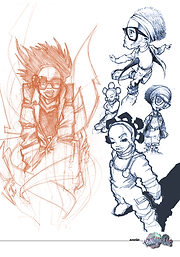

This African-American girl thirsts for knowledge. Curious, brilliant, and ingenious, she devotes her free time to reading scientific books and creating inventions like the THINGUMAJIG. She aspires to stand out in her field and surpass her role models, Newton or Einstein. Perhaps one day she will discover a new equation, akin to the famous E=MC², earning her the recognition of her peers and even a Nobel Prize.
Standard Power: Her shoes, another of her inventive creations, give her the ability to jump higher than the other children and reach places that would normally be inaccessible.
Hero Power 1 (Laurynn Apple): Apple sings in the style of Lauryn Hill. The Moths, enchanted by her voice, immediately faint. The townspeople affected by the “Haunted” affliction gradually regain their senses!
Hero Power 2 (Apple Copperfield): The girl reveals her magician skills to the players. She wraps herself in a curtain and emerges invisible after an explosion, amplifying the sense of mystery. She can choose, at any time and place, when and where she will reappear in full form.
Hero Power with a Watermelon in Arms: Apple squeezes the fruit, collects its juice, and mixes it with a viscous liquid of her own making. She then sprays this secret concoction onto nearby Aliens, causing their armor to melt. Totally exposed, the Moths flee, embarrassed by their nudity. If no aliens are nearby, the fluid spills onto the ground, forming a puddle that neither Moths nor the children dare to step into!
Wang, the Basketball Player:


This young Asian boy grew up in a disadvantaged environment, in the poor eastern district of Mollen City. He is passionate about sports and often skips school to play basketball. Wang is deeply devoted to those close to him and looks out especially for his friend Dafoe, for whom he feels responsible. Secretly, he dreams of achieving fame and surpassing his idol, Michael Jordan.
Standard Power: His excellent physical condition grants him the strength and endurance to scale gutters, fences, and other urban obstacles with ease. He can access parts of Mollen City that his friends are unable to reach.
Hero Power 1 (Kung Fu Master): Upon encountering an alien after activating his first “Hero” power, Wang showcases his karate skills. His impressive combo moves leave the stunned Moth trying to imitate him. Clumsy as it is, it fails miserably—only managing to get tangled up in its own limbs and tentacles.
Hero Power 2 (Tornado): After starting from a standing or crouched position—like in sprint events—Wang charges toward the Moth facing him. He then circles around it at supersonic speed, reminiscent of Taz’s spinning tornado. Suddenly, a vortex forms around the alien. Trapped and immobilized, the slimy creature begins to cry, and the flow of its tears soon transforms it into a watermelon!
Hero Power with a Watermelon in Arms: Wang can’t resist dunking anything he gets his hands on. He’ll start dribbling while mistaking the watermelon for a basketball, using the Moth as his opponent, then launch into an acrobatic jump before smashing the fruit onto the alien’s head. If no Moth is nearby, the watermelon will shatter on the ground, creating a slippery surface for any character who walks over it.
Mélanie, the Singer:


This young girl from the Old Continent appears closer to thirteen than ten, not only because of her imposing stature but also due to her remarkable intellect and distinctly atypical behavior. Apple and Melanie are inseparable friends. She wishes she could be more like her, yet she is far more serious and introverted. Unlike her companions, her unusual maturity for her age allows her to put things into perspective. She keeps a watchful eye on Wang, Apple, and Dafoe, making sure they don’t put themselves in too much danger—a protective “mother” figure. However, she sees her own caution as a form of cowardice and secretly longs to experience thrilling adventures.
Standard Power: Her discretion allows her to sneak behind an Alien or a resident of Mollen City and steal items from their inventory. She must act carefully, however, as at close range they won’t be easily fooled.
Hero Power 1 (Parappa the Rapper): Shy Mélanie transforms into a dynamic, confident dancer. She stands out with her elegance and outfit reminiscent of Olivia Newton-John in Grease. By keeping the rhythm—just like in a rhythm game—she convinces the Moth to dance along, wearing it out before herself.
Hero Power 2 (Cantatrice): Mélanie belts out a powerful operatic song. Her vocal range and projection are greatly enhanced, allowing her to hit high-pitched notes that act like a weapon for the player, disorienting and confusing the Moths.
Hero Power with a Watermelon in Arms: The watermelon Mélanie holds transforms into a bowling ball. She can launch it like a strike, hitting the opposing Moth and instantly neutralizing it. If no Moth stands in its path, the watermelon rolls through the streets of Mollen City until it hits an obstacle, having no effect.
Dafoe, the Firefighter:


This European is the youngest of the group, and it shows in both his boundless energy and his difficulty staying calm. His overflowing imagination, radiant optimism, and extraordinary ability to turn any situation into a game amuse Mélanie, Wang, and Apple. He constantly loses touch with reality, so much so that he convinces himself the Moths come from Disneyland rather than a distant galaxy. His carefree nature can endanger both his own safety and that of his friends. Dafoe recognizes in Wang the same rebellious spark—the same urge to challenge boundaries and reject constraints
Standard Power: Dafoe can crawl through ducts, underground passages, and narrow tunnels that lead to areas inaccessible to the other children. His small size allows him to overcome obstacles deemed impassable for the rest of the group.
Hero Power 1 (Fire Man): Dafoe has always dreamed of becoming a firefighter. In this “Hero” mode, his wish comes true. He wields a fire hose and sprays the Moths with water. Being hydrophobic, the aliens scatter and flee from him.
Hero Power 2 (Macadam Cowboy): Like all the kids, Dafoe imagines himself as an adult in the role of a police officer. To slow down the Moths, he dons the Sheriff’s outfit and enforces the law in Mollen City. He draws his revolver and fires into the air. Debris, resembling prison bars, falls around the alien, trapping it in place. Dafoe also shouts: “Bastard, you are under arrest!”
Hero Power with a Watermelon in Arms: Dafoe voraciously devours the watermelon, then targets nearby Moths by spitting its seeds at them. The seeds have a similar effect to Wang’s smashed watermelon, creating a hazard for anyone who dares cross his path.
The Moths, The Slimy Ones:
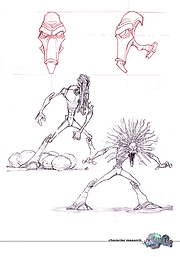

The Moths are a galactic-scale criminal faction determined to conquer new worlds. They have chosen to launch their assault on Earth from the Moon, starting with Mollen City, a quiet town in the United States that is easier to seize than a major metropolis like Washington or Moscow. They believe they can blend in with humans by adopting the clothing styles of the citizens of the Watermelon Capital. For beings from another world, they are not particularly quick-witted and often display clumsiness. True music lovers at heart, they go into a trance whenever they hear global Hits. So Viva Las Vegas, Viva Las Vegas!
Huppe Jumblatt, aka “Flint”, rules the Moth civilization with an iron fist, supported by seven loyal generals—the level bosses of Thingumajig: Oblon Ga (“Starr Co”), Tsuga Pops (“Cut Killer”), Garalus Boocer (“Cheewy”), Cerios Tagal (“Platoon”), Koom Pasiaa (“Ronald”), Onax Wrightii (“Mario”), and Spug Alum (“Coach”).
Despite the tensions among the extraterrestrial leaders, the eight senior Moth officers consider themselves brothers. They all hail from the same batch of Moth “watermelons”. Each possesses a distinct personality and unique traits, which translate into specific strengths and weaknesses that the children will learn before confronting them.
Each character plays a key role in Thingumajig. They support one another throughout their quest—no one is left in the background. Players will identify with one of the four kids, recalling memories of their own childhood, while the Aliens add a playful and lively twist to the gaming experience!
Thingumajig and Its Story: A Whimsical, Hilarious, and Gripping Tale
Under the leadership of the enigmatic General Huppe Jumblatt, the Moths—a horde of intergalactic rascals—roam the cosmos in search of a safe haven, far from the watchful eyes of the DGI (Galactic Interpol) and the bounty hunter Clean Westwood, aka “La Sang-Su”. During a frantic chase across the solar system, the aliens spot a small blue planet in the distance that sparks their curiosity.
Earth—a celestial body not listed in the IRC (Intergalactic Repertory Council)—seems like the perfect refuge to escape their pursuers. Moreover, humans, seen as a relatively undeveloped species, should be easy to subjugate.
The watermelon, a fruit cultivated by humans on Earth, possesses a composition strikingly similar to the humanoid-vegetal metabolism of the eggs in which Moth offspring develop. This unexpected parallel fascinates the aliens, who immediately recognize its potential. Overjoyed by the discovery, they see an unmissable opportunity to exploit this earthly resource to reproduce on a massive scale and colonize the planet.
Mollen City, a typically American town known by its residents as “Watermelon City,” represents the perfect region to begin the invasion of Earth.
Run for your lives! (Dafoe and Apple)

That is, of course, without counting on the courage of four children—true anti-heroes—who will stand in the way of Huppe Jumblatt and his subordinates. Being the only ones aware of the looming threat to humanity, they will never let the Moths achieve their goals. A heavy burden to bear for youngsters barely eight years old…
With the Thingumajig storyline now outlined, a careful, level-by-level reading of its plot becomes essential to grasp the ins and outs of its unpredictable and absurd narrative!
The Introduction: All Because of a Telescope
Using her avant-garde invention, the “THINGUMAJIG”, Apple peers at the Moon’s far side in search of its secrets. As she admires the lunar landscape, she is startled to spot the silhouette of the Moth Cerios Tagal through her telescope. Coincidentally, he has been observing Mollen City from Earth’s only natural satellite using an extraterrestrial telescope. This intense and unsettling visual encounter—a battle of gazes—frightens them both. Panicked, Apple rushes out of her room to alert her mother, who is washing the dishes after dinner. She begs her mother to come see the alien base she glimpsed on the Moon. But her mother refuses to believe her and scolds her: “Enough nonsense, go to bed”. Disheartened, Apple returns to her room. As she crosses the threshold, a gentle breeze brushes her skin. She notices that the window, which had been firmly closed, is now open. Glancing outside, she sees Moths fleeing from the scene of their mischief, carrying the “THINGUMAJIG” with them—they’ve just stolen her latest creation. Before she can fully process the situation, she watches a strange spacecraft take off toward the “Haunted House” in the “Countryside”, with those cursed thieves on board.
Storyboard excerpt 7 from one version of the introductory cutscene

Inside the spacecraft, the Moths examine the “THINGUMAJIG” from every angle. They bicker over it, trying to understand how it works and what it’s for. Handling it carelessly and pushing it to its limits, the machine suddenly gives way under the pressure, breaking into several pieces. Each of the seven Moth officers takes a fragment of the astrograph as a keepsake of their first steps on the blue planet. Huppe Jumblatt, furious, looks on with disdain at his comrades, frustrated by their incompetence and clumsiness.
Meanwhile, Apple contacts Dafoe, Wang, and Mélanie via their walkie-talkies to warn them of the danger. They unanimously agree that the situation is critical. They then meet in their treehouse atop the tallest tree in the forest to devise an effective defense plan. They decide to reassemble the “THINGUMAJIG” and, in doing so, prove the existence of the Aliens to the adults. Suddenly, a dull thud cuts their discussion short.
Without hesitation, the children rush out of their hiding spot to assess what’s happening. Right before their eyes, they witness a bizarre ritual. One Moth is placing a watermelon beneath an enigmatic blue light, and moments later, another alien mysteriously appears in the glow of the beam. The group of youngsters quickly realizes that the Aliens are multiplying—or duplicating—through this process. They have no time to lose if they are to protect the human race!
Important regarding the Storyboard excerpts from the archive:
-
The Storyboard (SB) for the introductory cutscene of Thingumajig 3DFX/Dreamcast consists of twelve excerpts. However, the SB does not fully align with the scenario described above or in the Game Design Document (GDD). The Storyboard frequently mentions Jabbar, a character ultimately not approved by the development team and later replaced by Wang.
-
It seems plausible that the scene’s sequence was rewritten between the SB and the GDD. This discrepancy is also explained by the fact that the game was still in development and nothing was finalized, or that Hopland needed to present something to investors. Feel free to consult the full SB on the annex page: [Additional Artwork and Storyboard Excerpts for Thingumajig PC/Dreamcast]
The Adventure: Fourfold Madness
The Campaign (Level 1 with Wang and Dafoe): The four friends decide to split into two groups. Apple and Mélanie set off to locate the alien spacecraft, while Dafoe and Wang stay behind. The Moths spotted under the tree slip away, retreating deeper into the forest, which is part of an Indian reservation. The two boys give chase, catching up to them near a farm, where they confront the creatures to identify their vulnerabilities. Along the way, they encounter the chief of the Indian tribe, Gémoniro (the tomahawk quest), face a bear (the honey jar quest), and befriend a beekeeper (the bee protection mask quest).
The Haunted House (Level 2 with Mélanie and Apple): Apple and Mélanie locate the UFO’s landing site in an area known as “The Zone”, a place feared by the residents of Mollen City. Overcoming their fear, the girls are forced to explore a haunted house along the way—no child had dared to venture there before them. After searching every corner of the dilapidated building, wandering through the nearby cemetery, and navigating the maze-like underground catacombs, they come face-to-face with the Moth spacecraft. Instantly, the spaceship’s metal doors close before it takes off to a new destination. Arriving too late, they contact Wang and Dafoe to inform them of what happened.
The Zone (Level 3 with Wang and Mélanie): A heavy sense of despair grips Apple and her companions as they wander through the labyrinthine streets of Mollen City. They have no idea how to prevent the Moths from multiplying, nor how to thwart the extraterrestrial visitors’ evil plan. Tsu Yang Lee, Wang’s grandfather, may hold the answer to the question that haunts them: how to ensure the survival of the human race? The venerable elder claims to have experienced an alien abduction in his youth, but to this day, no one takes his stories seriously. Determined to consult him, Wang and Mélanie head to his home. Obstacles slow the children’s progress, but they eventually manage to reach him. Over a cup of Chinese tea, he advises them to reach the highest point in the city to try to detect the trail of the spacecraft that just departed from “The Haunted House.”
Moth Technology

The Fairground (Level 4 with Apple and Dafoe): Dafoe and Apple, eager to spot the Moth UFO in the sky, choose the vantage point of the Ferris wheel at the fairground to get a better view. From there, they enjoy a panoramic perspective of Mollen City and its surroundings. But as time passes, dusk falls over the “Watermelon City”, complicating the heroes’ mission. Indeed, the ride does not operate at night—maintenance staff cut the power to the area every evening when the fair closes. Apple and Dafoe must therefore restore electricity by sneaking into the fairground’s technical room, located just beyond the Haunted Train. The aliens, of course, have no intention of remaining idle and will actively hinder the children’s progress through the amusement park. Once power is restored, the Ferris wheel automatically starts turning. The two protagonists immediately climb into a gondola to reach the top of the rotating structure. In the distance, they witness an unimaginable scene at the “Museum”. They then reunite with Wang and Mélanie to share what they have seen.
The Museum (Level 5 with Dafoe and Wang): The T-Rex fossil displayed at the Museum of Man accidentally comes back to life due to the “Haunted” screams of a Moth in the midst of a delirious fit. The prehistoric creature, ridden by the irrational alien, rampages through everything in its path. The children must stop them at all costs before the entire collection is destroyed and before the pair ventures out into the streets of Mollen City. Facing this danger, the four kids split up again. The daring Dafoe and Wang confront the Tyrannosaurus and its master head-on, ultimately defeating their enemies. However, the finishing blow triggers a disastrous consequence: the T-Rex skeleton collapses on top of them. Dafoe barely escapes the rubble, but Tsu Yang Lee’s grandson, trapped under the creature’s ribcage, finds no way out. Tragically, Moths capture him and drag him toward “The Mall” before Dafoe can rescue him. Choking back his emotions, he radios the rest of the group to inform them that Wang is in serious trouble!
The Mall (Level 6 with Mélanie and Dafoe): Mélanie and Dafoe rush to the Mall to rescue Wang. Their agility and physical prowess give them the edge, allowing them to sneak into the shopping center undetected. Wang, still trapped in his bony prison, watches his life flash before his eyes. His suspended cage gradually descends toward a water-filled basin, putting him at risk of drowning. Fortunately, Dafoe and Mélanie manage to rescue him just in time before the cage is completely submerged. The Moths, meanwhile, flee in a panic. During their hasty retreat, they inadvertently scatter watermelon seeds, much like in “The Tale of Tom Thumb”, which will lead the Thingumajig Goonies straight to the “Residential District”.
The Residential District (Level 7 with Apple and Mélanie, partially playable in the prototype): Apple and Mélanie track the Moths through the Residential District to a warehouse, following the traces left behind. Despite wielding technology that defies known laws of physics, the aliens are not particularly clever. Deep inside the warehouse, they spot the interstellar ship first seen in “The Campaign”. Curiosity piqued, they board it—and what horror awaits! The Moths have stored an enormous quantity of watermelon seeds, likely looted from Mollen City. Determined against all odds, the girls convince themselves to steal the spacecraft to travel at light speed to the alien lunar base and eliminate the extraterrestrial threat once and for all. Unfortunately, the saucer is broken and refuses to start. Apple inspects the engine compartment and realizes a crucial component is missing. She remembers seeing a spare part in her parents’ garage and rushes to retrieve it, aided by Mélanie, before the Moths can repair the UFO themselves. On the landing step of the family home, Apple hears noises coming from the shed. The Moth chief mechanic is rummaging through her father’s workbench, searching for the very same part. Refusing to let him take it, the girls confront him in a fierce struggle. The Moth ultimately concedes defeat. Apple and Mélanie repair the spacecraft and wait for Dafoe and Wang. Finally, the children take off together toward the Moon, ready to face Juppe Humblatt.
The children’s future new treehouse

The Moon (Level 8 with Wang and Apple): Upon entering lunar orbit, the group of friends loses control of the spacecraft and crashes into a massive Moth military fortification, as vast as the watermelon plantations that cover part of the moon. Shh… they love gardening. It’s important to remember that the aliens established themselves on the Moon as the optimal starting point to invade Earth. Wang and Apple take on the role of scouts, while Dafoe and Mélanie stay back to cover their rear. The kids eventually confront Juppe Humblatt, defeat him, and blow up the alien headquarters. It’s the final nail in the coffin for the Moths—no one will ever hear from them again!
Epilogue: Apple, Wang, Mélanie, and Dafoe return to the surface of the blue planet aboard one of the few escape pods that remained undamaged from the Moth mothership. The pod comes to a sudden stop on the outskirts of Mollen City. Although it provides undeniable proof of extraterrestrial life, as foreshadowed at the beginning of their adventure, the group of friends decides to keep it a secret. Otherwise, the U.S. government would confiscate it and possibly erasing all traces of their discovery. The children take advantage of the situation to modernize their treehouse, using alloys composed of substances not listed on the periodic table. Too bad for Apple’s Nobel Prize aspirations!
The opening scenario of Thingumajig sets the player on the trail of a classic alien invasion adventure. The developers deliberately mislead them, ready to bewilder and immerse them in a delirious escapade. Gradually, everything spirals out of control. Yet, the telescope-based stare-down between Apple and a Moth already hinted at their mutual desire to surprise!
Thingumajig and Its Game Rules: The Watermelon Festival
The “rules” of a video game encompass the constraints and objectives that define its flow, the behaviors allowed or forbidden, the actions permitted or prohibited, fairness, and the interactions between the player and the game. They include a clear goal, the core mechanics, the gameplay loop (goal–challenge–reward), balancing, and Game Design elements like the camera, controls, and character. Here are some of the quirky rules that govern Thingumajig and help ensure fun for everyone:
Rule #1: Find all the watermelons scattered throughout the level and bring them to a secure location to prevent the Moths from reproducing. The children will sometimes outsmart the situation by activating secret devices to reveal the fruit’s hiding place or by using their unique abilities to reach it. When Mélanie, Apple, Wang, or Dafoe are holding a watermelon, they can no longer run.
Rule #2: The original Moth progenitors do not collect the watermelons themselves before the children do. Their clones, spawned from the watermelon’s insemination, will handle this task instead. Terrified Mollen City residents in “Haunted” Mode will also help, carrying the fruit under the mysterious blue beam to incubate it. After 120 seconds in the incubator, the watermelon transforms into an Alien duplicate.
Rule #3: Hidden objects in the level can restore the human appearance of Mollen City residents and heroes affected by the Moths’ screams. Once used, they will awaken from their “Haunted” lethargy. For example, the baker will regain her liveliness if you bring her a baguette.
Rule #4: The player can interrupt the alien artificial incubation process by retrieving the watermelon from beneath the machine and tossing it into a water source. The fruit will instantly bloom upon contact with the liquid. The kids can then collect pollen from its stamens, which can be used to lift the “Haunted” curse from zombified Mollen City residents—another way to cure them. Retrieving a watermelon from under the incubator is dangerous, as Apple and her friends’ heart rates will spike dramatically, risking serious injury. However, accomplishing this heroic feat will boost the Thingumajig protagonists’ courage, allowing them to gain their superpowers more quickly!
Sheriff, scare me!

Everything revolves around the watermelon. The Thingumajig developers had a true cult-like devotion to this fruit—undeniably delicious! And why not the grapefruit instead?
The Thingumajig Demo: A Sneak Peek at Its Wacky Concept
It’s important to understand that before the advent of engines like Unity or Unreal, programmers had to code their own engines as well as the tools required by their project entirely from scratch. This creative process demanded an enormous amount of time and effort. Nowadays, this specialized skill is fading due to the standardization of game development. For Thingumajig, just one or two developers handled this task. Suffice it to say, the Polygon Studio team—made up of only eight employees—was far from having the manpower needed to begin creating a full-fledged video game.
The Alpha prototype of Thingumajig examined below is akin to a Vertical Slice (a playable version of a game lasting around 10 minutes that demonstrates the intended experience) or a proof of concept (a demonstration of an idea’s feasibility). The costs of producing demos of this kind add up quickly and can easily exceed €100,000. This is normal, as they define the future of the game in question and generate interest from a publisher willing to fund it.
This early version of Thingu does not reflect the product as it would have been sold in retail stores. At this stage, nothing was final. Many aspects were bound to evolve through experimentation, testing, research, and iterations. Its development had only just begun!
The Thingumajig Vertical Slice: a game to try
A thorough investigation of the Thingumajig prototype reveals that the build was created in September 1998, based on the digital timestamp displayed in the background of its Main Menu. However, a second date—October 26, 1998, at 11:58 PM—appears to take precedence, corresponding to the last modification of the game files (the executable GAME.EXE). Although this Demo ends quickly, it still allows players to grasp the core gameplay of Thingu and to catch a glimpse of its avant-garde concept.
Three tools are hidden within the beta build. Two of them relate to the shadow and lighting settings of the PS title—perhaps the trick to soften the pervasive darkness on the screen when playing (explanation given below). The third program launches for a fraction of a second at the start of the prototype. It likely concerns Motion Capture and AI.
Certainly tools handmade by the programmer(s)


The build launches to an elegant Main Menu by double-clicking the Thing.EXE icon. It offers the following options: start a Thingumajig session (START GAME) – view a series of screenshots or photos from its development (PICTURE GALLERY) – memorize the keyboard control configuration (CONTROL LIST) – access the credits and contact information for Polygon Studio (CREDITS & CONTACT) – or exit the game (QUIT). The GAME.EXE executable allows the player to bypass the Main Menu and load a game directly. However, the demo crashes when launched using GAME.EXE.
This Alpha version of Thingumajig offers an entry point into the surreal universe of Polygon Studio’s creatives. Throughout the demo, they guide the player across an urban enclave of a peaceful, imaginary American town. During exploration—by night, on foot, or on a skateboard—the player observes the distorted yet uniform architecture of the residential houses. The guided tour of Thingu leads them to shiver in a cemetery, marvel at a church (a nod to Beetlejuice’s residence?), sneak into the yards of lavish properties equipped with pools or playgrounds, get lost in the alley behind the cinema, wander into a vacant lot, ponder over a vintage gas station, and even stroll through a basketball court. However, the tourist brochure fails to mention that creatures from another world will disrupt the excursion through Thingu.
The prototype introduces the primary intention of Polygon Studio’s title. It outlines the hide-and-seek mechanic and emphasizes overcoming the character’s fears. For example, aliens will obstruct Apple’s nighttime stroll through the level, relentlessly pursuing her until she manages to shake them off. A temporary suspenseful soundtrack kicks in, and the view switches from isometric to third-person when she comes face-to-face with them. The camera returns to its original position once the danger has passed. Cleverly, the young girl slows them down by playing boogie-woogie on a radio, giggling just at the thought. Indeed, the Jamaican extraterrestrials start dancing wildly while she sneaks away. Resourceful, she sometimes hides inside a trash bin, waiting for them to move on, her heartbeat racing all the while!
A Face-to-Face with Aliens

Romain Gauthier: « There’s no Sound Design in this Vertical Slice, and the music was never composed for or implemented in a level. These were demos I had made. The sound effects weren’t mine either, except for some voice tests: the laughing kid’s voice was my 5-year-old cousin at the time!!! »
A yellow arrow indicates spots where interactions with objects or elements of the environment are possible.
The "F6" key, which does not appear in the CONTROL LIST menu, is actually used to reveal the locations of trash cans, radios, skateboards, and Martians in the level. Additionally, other keyboard keys correspond to the Free Camera option. Here’s how to use it:
This rhythm that carries them through the night awakens in them…

Q & A : Move the camera up or down while keeping the character on a vertical axis.
Z & U : Raise or lower the camera around a fixed point—centered on the character—while tilting horizontally as close as possible to them.
+ & -: Move the camera forward or backward.
?????? (Yet to be discovered) : Rotate or orient the camera in any desired direction, or spin it around the character. Screenshots in the GALLERY menu seem to confirm this functionality.
Conclusion : Although the demo is well executed overall, it lacks a central element. It is missing a scripted progression within a mission, which would allow players to envision the final game and clearly understand how Thingu’s unique gameplay would unfold within a narrative framework—without risking player fatigue.
Instructions for playing correctly
The Polygon Studio team designed this beta of Tingumajig in 1998 to run exclusively on a computer equipped with a 3DFX graphics card (popular among gamers during the 1990s). To play it three decades later, the prototype now requires the installation of a Glide Wrapper, which emulates this PC video adapter from Nvidia's competitor that disappeared in 2000. DgVoodoo 2 (download link) is the most reliable of those tested. The game will start without crashing once the Wrapper’s .dll files are downloaded and placed in the correct folder within the Thingumajig directory.
Map layout of the Vertical Slice

When launching the Thingumajig demo with the Glide Wrapper properly configured, two windows will open: the game window and another white one called NECTAR (the Thingu engine). Place the mouse cursor in the second window to take keyboard control of Apple and move her around in the Residential District level.
Compatibility issues with modern PCs persist despite the use of the Wrapper. They can affect the proper functioning of Thingu in various ways: the frame rate drops suddenly, the game stutters, a 3DFX watermark appears once a session is started, and the “R” key (Replay) behaves strangely, sometimes causing the game to crash.
The low overall lighting in the Polygon Studio project may stem either from an unintended rendering caused by emulating a Voodoo graphics card, or from the default game configuration deliberately set by the developers using the aforementioned tools. The Wrapper allows you to adjust Thingu’s brightness via the “Contrast” slider in the DgVoodoo 2 program. This improves visibility, but a disturbing fog appears. The shadow and lighting effects are less impressive with this setting. To each their own…
In-game rendering with the 3DFX logo (performance issues, running in slow motion)

Modified rendering with fog (no performance issues, no 3DFX watermark)

1998 screenshot (Free Camera) with original lighting — good visibility while preserving the light effects

The “R” (Replay) button behaves differently depending on the game’s current state. In isometric view, with performance issues and the 3DFX watermark at the bottom-right of the screen, it transports the player to the encounter with the alien near the church. In TPS mode, the AI automatically controls the girl. In Diablo-like camera or third-person view, without the graphics card logo and with slight stuttering, it takes the character to the city cemetery. The prototype crashes when pressing “R” if the animations are perfectly smooth. Strange…
With the concept of Thingumajig understood, the prototype downloaded, the Wrapper installed, and its operational quirks known, you are ready to venture into a Burtonesque world!

You can download this 3DFX Thingumajig prototype below:
The documents of Thingumajig
Madjid Taibi (many thanks to him) contributed to the writing of this article by providing the site with his archives related to Thingumajig, thus offering a valuable insight into a largely unknown and underestimated project. However, the Game Design documents (the game’s bible, Thingu’s feasibility, email exchanges between SEGA and Polygon Studio, etc.) cannot be made public due to several factors. Here are a few examples, each accompanied by a photo to provide context:
Thingumajig Technical Design Final3

1- Thingu Overview

2- Conceptual Design

Thingu le jeu

thinguMajig

Package Thingumajig

-
Thingumajig Technical Design Final3: The Technical Design Document (TDD), written in French, carefully details the technical design of Thingu, including aspects such as its architecture, engine choices, physics systems, artificial intelligence, sound, and much more.
-
1- Thingu Overview / Thingu le jeu: These documents, written in both English and French, outline what players will see in Thingumajig and the overall atmosphere it aims to convey.
-
thinguMajig / 2- Conceptual Design: These documents, printed in both English and French, correspond to the specifications and the Thingumajig game bible (Game Design Document). They contain all the essential information for the development team to maintain a clear direction throughout the production of Thingumajig, and of course to design it. Some of the topics covered in detail in the GDDs include: the overall concept, the game rules and mechanics, the storyline, and the presentation of characters and enemies.
-
Package Thingumajig: A checklist listing the Thingumajig presentation file and the remaining tasks or improvements needed to refine it, with the goal of pitching the game to a publisher.

Not all the Conceptual Material made available to me for this article could be used. The rest—a Storyboard and additional Artworks—can be found on the secondary page: [Additional Artwork and Storyboard Excerpts for Thingumajig PC/Dreamcast]
I would like to thank Terry Proto, Romain Gauthier, Stéphane Tartelin, and Madjid Taibi for their availability, kindness, and for providing us with conceptual material from Thingumajig. Their testimonies allow us to discover an unreleased game unknown to 99% of us!
I would like to thank the entire Polygon Studio team involved in the studio’s various projects, including Thingumajig (see Zoombinis: Mountain Rescue on MobyGames).
Special thanks to:
-
Kailokyra for proof-reading the French text
-
Neil Riddaway for the English correction of the article
-
Benedikt Scheffer for designing the cover
Similar prototypes (Unreleased): Agartha (DC) - Emulateur officiel Megadrive (DC) - Castlevania Resurrection (DC) - Half Life (DC) - Dalforce XOP (DC) - Flinstone (DC) - 4 x 4 Evolution PAL (DC) - Ring : L'Anneau des Nibelungen (DC) - Ecco 2 (DC) - Kyskrew (DC) - Propeller Arena (DC) - Geist Force (DC) - Scud Race Tech Demo Dreamcast - Shenmue 2 US (DC) - The Red Star (XBOX) - Heaven's Drive ( version japonaise de Burnout 1) pour PS2 - Jekyll and Hyde (DC) - The Grinch Jap (DC) - Worms Pinball (DC) - Quake 3 Arena version japonaise (DC) - Vectorman PS2 - Fear Effect Inferno PS2
Feel free to try out [The Dreamcast Unreleased Games to Download] that I found. For the more curious among you, I also wrote [The List of Cancelled Dreamcast Games], which references all of them along with information about each title.
