


Additional Artwork and Storyboard Excerpts for Thingumajig PC/Dreamcast
This secondary page catalogs the conceptual material for Thingumajig PC/Dreamcast—Storyboard panels and Artworks—that were not included to enhance the main article dedicated to this Unreleased Polygon Studio title: [Thingumajig 3DFX and its Demo: An Intimate Polygon Studio Game Intended for the Dreamcast, Which SEGA Had Considered Publishing].
In 1998, a small team at Polygon Studio (PS), a young French development studio born from the creation of Felony Pursuit PC/Dreamcast, was simultaneously programming the Thingumajig project. The designers never succeeded in releasing their innovative game. SEGA had planned to publish it exclusively for the Dreamcast, but the Japanese company backed out at the last minute, just days before finalizing the agreement with PS’s management.
Thingumajig on Dreamcast or PC (3DFX) follows the wild adventures of four teenagers facing an alien invasion. The Moths, repulsive aliens with long tentacles, choose Mollen City—the children’s town—as the target for their offensive. Wang, Apple, Mélanie, and Dafoe, the game’s anti-heroes, fight back by traveling to the Moon, destroying the alien headquarters, and razing the Mothian watermelon fields. Surprisingly, this Earth fruit sparks the aliens’ desire, as it provides them with the means to reproduce rapidly and in large numbers.
This Action/Adventure game adapts the concept of hide-and-seek to a video game format. For instance, the children can hide in trash cans or tree stumps to evade or shake off the Moths. A brilliant idea that was either barely explored or hardly used in the late 1990s.

The cover page of the Sketch Book sent to publishers
Today, a demo coded for the 3DFX graphics card—available for download on the homepage of the preservation project dedicated to Thingumajig—allows players to experience this little-known game. The Artworks and Storyboard excerpts featured in this article also provide an overview of Thingu, whose development had only just begun.
Thingumajig doesn’t leave anyone indifferent: a charming Art Direction reminiscent of Tim Burton’s cinematic universe, a zany and parodic storyline, absurd game rules, and a playful concept. Yes, there was really something special to be done with this game!
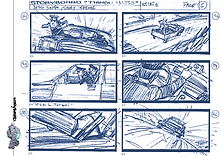
A draft of the opening sequence of Thingumajig in Storyboard form
This Storyboard (SB) depicts, shot by shot, one of the earliest versions of the opening scene of Thingumajig. The cinematic writing evolved between these sketches and the scenario later detailed in the Game Design Documents. This SB-introduced prelude does not match the one described in Polygon Studio’s official game brief. Among other things, the character Jabbar, shown in the Artwork below, appears in the storyboard drawn by Madjid Taibi. This child was later replaced by Wang.
The Storyboard Plot:
Police officers, lights flashing, pursue an old American pickup through the streets of Mollen City. Two individuals, brothers, have just stolen a shipment of watermelons. They do not act instinctively and seem possessed by a supernatural force, both physically and psychologically. Indeed, extraterrestrials are exerting mental control over them (the “Haunted” mode). The crooks throw watermelons at the law enforcement officers to shake them off. The high-speed chase rages on.
Meanwhile, atop a cleared hill, Apple, Dafoe, Mélanie, and Jabbar (Wang) are peering at the Moon with the “THINGUMAJIG,” a revolutionary telescope. Suddenly, they hear tires screeching and engines roaring. Curious, they point the THINGUMAJIG’s lens toward the road below, from where the sounds are coming, to see what is happening. They witness a live high-speed chase—when suddenly, the unthinkable occurs.
The Storyboard section of the Sketch Book

A flying saucer suddenly appears out of nowhere and crashes into the fleeing vehicle, sending it rolling. The patrol car brakes and comes to a halt. Police officers, keeping their composure, exit the vehicle, take cover, draw their weapons, and train them on the occupants trapped inside the wrecked car. The only undamaged door creaks open. A watermelon rolls out and heads straight toward the officers. Halfway there, the fruit transforms into a repulsive creature—a Moth. The sheriff’s deputies, frozen in fear, are turned into zombies by the alien’s screams before they even have time to fire, just like the criminals they had been chasing.
*** THE END ***




The film The Goonies, which inspired Thingumajig, also begins with a chase scene, doesn’t it? Regardless, the way the children discover the existence of the Moths in the GDD(s)—through telescopes—is far subtler and much more amusing!
Even more Thingumajig Artworks
The Artworks below serve as a foundation for establishing the aesthetic vision of the Thingumajig heroes: Apple, Dafoe, Mélanie, and Wang (formerly Jabbar). These concepts illustrate the creative process behind the game’s characters from various perspectives and do not necessarily reflect their final appearances (Normal mode – Hero 1/2/3/4 mode – Haunted mode) as validated in the Game Design Documents.
Design explorations for Dafoe and his “Hero” or “Haunted” appearance (not necessarily representative of the final choices)


Design explorations for Apple and her “Hero” or “Haunted” appearance (not necessarily representative of the final choices)


Jabar, an unapproved kind, was replaced by Wang

Design explorations for Melanie and her “Hero” or “Haunted” appearance (not necessarily reflective of the final choices)


Design explorations for Wang, focusing on his appearance as a basketball player

La "French Touch" avec Thingumajig

How can one not grow attached to these adorable children? How can one not be moved while experiencing their dreams through our own eyes?
I would like to thank Madjid Taibi for his availability, his kindness, and for providing us with Thingumajig concept material. His archive of Artworks and Storyboard excerpts allows us to immerse ourselves in the world of Thingumajig.
I would like to thank the entire Polygon Studio team involved in the studio’s various projects, including Thingumajig (see Mobygames entry for Zoombinis: Mountain Rescue).
Special thanks to:
-
Kailokyra for proof-reading the French text
-
Neil Riddaway for the English correction of the article
Other special pages dedicated to a game, featuring Artworks, Storyboards, etc.: Vectorman PlayStation 2 (Unreleased) - Evil Twin Dreamcast - Jekyll & Hyde Dreamcast (Unreleased) - Propeller Arena Dreamcast (Unreleased) - Fear Effect Inferno PlayStation 2 (Unreleased) - Quark Dreamcast (Unreleased) - Thingumajig PC/Dreamcast (Unreleased) - Agartha Dreamcast (Unreleased) - Pilgrim: Faith as a Weapon PC
The [Artwork & Concept Art Database] page lists all pages created exclusively around the concept art of a given project. It also brings together all articles related to video games covered by the site—often making-of features—that have drawn on archives of conceptual material provided by developers to support their writing.
