


Agartha Dreamcast and Its Prototypes: Discovering the Spiritual Successor to Alone in the Dark
Alone in the Dark was released on PC in 1992, a title that would revolutionize the genre. Created by Frédérick Raynal, it is regarded as one of the earliest Survival Horror games, placing the player in a 3D environment where dynamic camera angles provide a cinematic presentation. This innovative approach allows the player to see the character and their surroundings from carefully chosen perspectives, heightening the stress and tension inherent to Adventure games. Beyond the simple video game experience, the player becomes both an actor and a spectator in their own odyssey!
After SEGA acquired Adeline Software—acquiring only the studio's premises and staff, not its licenses—the studio became No Cliché. Raynal and his team wanted to reinvent the genre and surpass high-quality productions such as Resident Evil and Silent Hill. This desire for innovation became the key driving force behind the project in development, which would come to be known as Agartha.
Frédérick Raynal: « The head of SEGA, and all those people, wanted the games to be good. They believed that if the games were good, the console would succeed. They weren't caught up yet in the PS2 hype and its marketing. For them, it was all about making great games first and foremost. That was the last time in my career as a developer that I ever heard a publisher talk like that. »
Unofficial Agartha Dreamcast Trailer
The Team During the Adeline Software Era

Agartha builds upon the situational gameplay concept “invented” by Alone in the Dark, while introducing the notions of “Good” and “Evil”, which influence both the gameplay and the storyline, with tangible consequences for the world and its characters. These innovative gameplay mechanics positioned No Cliché’s new Survival Horror as a precursor to games featuring moral alignment systems. With Agartha, the player makes choices—and must live with their consequences. The environment is no longer a fixed backdrop; it changes and adapts to the actions of the man or woman behind the screen. However, following its cancellation, it would take until the release of Microsoft’s Fable in 2004 for a game to come close to realizing the ideas envisioned for Agartha Dreamcast.
Didier Quentin: « What we wanted was to take risks and be innovative, both technically and in terms of the concept itself and its storytelling. Being a studio funded by SEGA allowed us to take this approach, which was admittedly quite unusual, because the Japanese publisher placed complete trust in us. We were given almost total creative freedom. »
Launching a Prototype

Designed to fit on a single GD-ROM by using real-time cutscenes generated directly by the game engine, Agartha was set to immerse Survival Horror fans in an open-world virtual experience. The development team was aiming for an average playtime of around 20 hours, with strong replayability encouraging players to explore its alternate paths and discover its two distinct endings.
Didier Chanfray: « As for the size of the world, it’s difficult to be precise without having the complete progression mapped out, but there is one principle to respect in Survival Horror games (I remind you that Frédérick Raynal wanted to return to the genre): it shouldn’t be too large. »
A Selection of Menus and Loading Screens

The French developers would invite the player quite early in the game—or perhaps even directly from the Main Menu, before it was actually needed—to try a mini-game on the Dreamcast’s memory card: a puzzle that had to be assembled. Unlike the few titles on the console that made use of the VMU’s capabilities, this puzzle was an essential part of progressing through Agartha’s storyline, rather than a simple optional diversion as found in other Dreamcast games. A first!
Frédéric Raynal: « You had to reconstruct a protective talisman from four pieces in a mini-game on the VMU itself, in order to avoid being cursed. You could do it long before you actually needed it. Reconstructing the talisman was mandatory to progress through a later stage of the main game. »
Although a topographical map already existed, the No Cliché team also built a two-by-two-meter scale model representing the environments of Agartha. This model served as a creative tool during development and provided a more precise understanding of the game world and its layout.
Frédéric Raynal: « The entire game world was represented as a scale model. Benoît Boucher kept it at his home for many years, until he eventually ran out of space. »
The map, a sketch, and the scale model of Agartha’s game world
.jpeg)
.jpg)


Scheduled for release in October 2001, this promising title would never see the light of day. Sadly, SEGA’s decision to discontinue the Dreamcast in 2001 sealed the fate of Agartha, No Cliché, and the ambitions of Frédérick Raynal and his team. The project was cancelled, leaving Survival Horror fans with a bitter taste of what might have been.
Frédérick Raynal: « The discontinuation of the Dreamcast was the worst thing that ever happened to me. Those were my best years as a developer at SEGA —except for the end. When the executives call you in and summon you to headquarters, you start wondering, ‘What’s going on?’ The managers were there, all 150 developers were present, and SEGA announced that they were ‘shutting down’ without being able to tell their employees anything before the official announcement a month later. »
Unlike the rest of the team, Frédérick Raynal and Didier Chanfray quickly learned that SEGA was planning to discontinue Dreamcast production and withdraw from the console market. Nevertheless, they continued working on Agartha, maintaining the status quo in order to enrich the portfolios of No Cliché team members with the technical demos available below, which they could later show to potential employers.
Photo of two game prototypes

Didier Quentin: « It was more than just a technical prototype. We had already incorporated some of the visual assets that had been produced, to see whether all of this could fit within the Dreamcast. We also already had an early version of a real-time staging tool. »
To give the impression that everything was proceeding as planned and avoid raising suspicions among their employees about SEGA’s precarious situation, Didier and Frédérick set E3 2001 as the deadline for completing one of Agartha’s demos. This explains the presence of the E3 label in the files of one prototype, even though the game was never shown at the Californian trade show. No one at SEGA, outside the small circle of No Cliché employees, ever conducted internal testing of this promising title.
Didier Chanfray: « We had finished pre-production and were starting production when we learned that everything was going to come to an end. The assembly phase was still missing, but all the tools needed to make the game were already in place. We were about 10% into production itself; everything was well established. »
Today, several prototypes, artworks, and testimonies from former No Cliché employees reveal what the team envisioned for this groundbreaking title.
The Atmosphere: The Hollow Earth Mythology
Agartha on Dreamcast is unlike any other Unreleased title. It remains fascinating to analyze and dissect. Its videos, testimonies from former No Cliché team members, and surviving prototypes reveal very little and, paradoxically, a great deal at the same time.
Every detail matters: the smallest texture, the interior layout of a cottage, or the precise placement of objects in a particular location invites interpretation, leaving no room for coincidence.
Everything has a meaning!

To set the mood before continuing with this article, here is a translation of a texture written in Sanskrit, which may be related to the talisman that must be reassembled in the VMU mini-game:
When the stars align above the sacred mountains, the passage to Agartha will open. The Sentinel Y'aga Heer'GHta awaits in the depths, guardian of the knowledge of the children of the First World.
Only the chosen one of the Sennacherib, born when Scorpio enters Virgo square, can seal or unleash the ancient forces. The ritual requires the blood of a direct descendant to activate the links between the surface and the depths.
The Twilight Conspirators seek to awaken that which must remain asleep. The Order of the Sennacherib must protect the seals and prevent the return of the fallen forces. The underground city must not be opened before the inevitable devastation.
May this message guide those who know the signs. The kingdom of the King of the World remains hidden from profane eyes. Only the initiated can decipher the path of the great migrations that leads to the gates of Hell’s antechamber.
A Bit of History: The Story of Agartha
The game takes place in a village lost in the snow-covered mountains of Romania during the interwar period, in a remote and difficult-to-reach region of the country. An earthquake triggers the opening of Agartha, an underground gateway between Earth and an infernal dimension. The villagers begin vomiting a blue liquid before losing their human form. When the dead rise from their graves, Kirk, a white-bearded specialist in paranormal phenomena, begins his investigation.
Photograph of a traditional Carpathian building and its integration into the game as a hunter’s cabin with a similar design


Didier Quentin: « I was the Senior Game Designer. I was assigned to Agartha from the very beginning of the project. So I was responsible for the game design and for writing the script (I was also the writer). I was also the one who came up with the idea of the Hollow Earth. Of course, I received regular input from Fred Raynal and worked closely with Didier Chanfray on everything visual. »
It is worth noting that the No Cliché artists spent a week or two in the lands of Dracula for the purposes of the game. This scouting trip was documented in a journal and illustrated with photographs—something we would love to see one day, who knows. And while we're at it, we certainly wouldn't say no to some photos of No Cliché, its offices, and even its carpet. The latter still bears the marks of the birthday parties the staff used to celebrate there in the evenings after work!
Didier Quentin: « The outdoor environments were partly inspired by real locations. We sent two artists there, and they came across what was essentially an open-air museum showcasing rural and mountain life from days gone by. As for the gigantic interior environments, such as the caves and the labyrinth, those came straight out of my twisted mind. »
Kirk travels to the site of the earthquake to investigate what he considers to be a strange movement of the Earth’s crust. This unnatural cataclysm is responsible for an outbreak caused by the opening of a fissure leading to the Hollow Earth. A cult triggered the seismic event, but Kirk will only discover this much later in his investigation.
The map of a labyrinthine level, with a reference to its stained-glass symbol in the temple. Coincidence?
.jpeg)

After a few hours of gameplay, the player discovers that the story, which initially appears fairly conventional, becomes increasingly complex and takes a supernatural turn. Kirk was, in a way, drawn to this inhospitable place. The earthquake was far too unusual to have predicted that it would capture his attention. To the cult, this middle-aged man is merely a means to a very specific end: his half-sister, who lies at the heart of this malevolent religious movement’s plans.
Kirk’s half-sister, Julie, has Tibetan ancestry whose significance goes far beyond simple genealogy. Through this ancient lineage, she is connected to those who, thousands of years ago, imprisoned the demons deep within the Hollow Earth. She is therefore the ultimate “key” the cult seeks to break the curse and set them free. Without her, no ritual can succeed!
One of the Cult’s First Demons to Be Confronted

Didier Quentin: « It’s possible that Julie was a temporary ‘working’ name, as we used to call them. We probably would have chosen a name that better matched her backstory. That’s not necessarily something you decide very early in production. We had a modeled version of her head intended for close-up shots. »
Thus, the heart of Agartha’s story lies not so much with Kirk as with his half-sister. Following in the footsteps of her missing half-brother, Julie will expose herself to a danger of which she is completely unaware.
Didier Quentin: « The player was also supposed to control her. This meant that the Survival Horror would allow the player to step into the shoes of two different characters, each with their own weaknesses and their own narrative arc. »
It is important to understand that, while playing as Kirk, the player could influence his half-sister’s fate: betray her and lure her into a trap by siding with the cult, or summon her to come to his aid if the cult held him captive.
Didier Quentin: « This is where we touch upon the concept of duality, even if only in broad terms within the story—the central theme that guided all of our design decisions. At first, without realizing it, and then increasingly consciously as the game progressed, the player was encouraged to make more and more choices between Good and Evil. »
The survival aspect of Agartha goes beyond simply dealing with attacks from infected creatures while having limited weapons and ammunition. It also shapes the narrative, ultimately pushing it toward either Good or Evil during the final part of the story, leading, naturally, to two diametrically opposed endings.
Frédérick Raynal: « That idea has stayed with me throughout my career in video games. I don't like games where you kill humans, regardless of the circumstances. I've always found that strange. And now, on top of that, people talk about the normalization of violence. That's why I was perfectly fine with killing zombies! »
The cult developing the virus. Didier Chanfray: “Another story about a virus, completely fabricated to take over the world.”
The infected, essentially the game’s equivalent of the undead, spread the disease by vomiting on the people they attack. They differ from traditional zombies, which typically devour human flesh or brains. In Agartha, the disease forces the infected to release the pathogen through their vomit. The infection therefore spreads through bodily fluids.
Didier Quentin: « Indeed, Julie carried within her what was needed to make the cure. I no longer remember all the details, but yes, curing the infected was one of the possibilities. »
.jpg)
Kirk could also become infected, forcing the player to drink constantly or seek treatment without delay. His health bar would drop rapidly—perhaps even too rapidly—further intensifying the game’s survival mechanics and overall difficulty!
The cult’s objective was not to spread the infection on a large scale. Its primary goal was to protect its territory and carry out its secret activities away from prying eyes. An army of zombies tasked with defending its domain served this purpose perfectly. The cult was pursuing an ancient secret known as the Hollow Earth—in short, a theory that a vast void exists within the Earth itself, concealing untold powers.
Didier Quentin: « For Agartha, we chose to portray demons buried deep beneath the Earth, waiting for the right moment to return to the surface and reclaim their place by wiping out humanity. »
The Avalanche: From Concept Drawings to Its In-Game Effects
.jpg)

The cult’s followers seek to harness the demons’ power to enslave humanity and rule the Earth. However, they are unaware of the true extent of the power held by these servants of Satan, who, for the time being, are content to cooperate, delighted to rely on humans to help them reach the surface once again. By triggering the first fracture in the Earth’s crust—the earthquake that sets the story in motion—the cult inadvertently causes the virus to emerge in the region. They ultimately see this as the perfect opportunity to carry out their occult practices undisturbed. At least, until Kirk shows up!
Reading this chapter only fuels the desire to discover the full story. The broad outline of Agartha’s plot is already captivating, with its tension and twists and turns!
Kirk: Agartha’s John McClane
Although Kirk is controlled from a traditional third-person perspective, Agartha introduces several new features compared to the earlier Resident Evil games: the game is fully rendered in 3D. Kirk carries a backpack, allowing the player to manage their inventory as they see fit. The backpack contains a pistol and a magazine, binoculars, a camera, a book, a pencil, a passport, a key, an oil lamp, and a flashlight. Kirk must keep an eye on his Life meter and his Vril meter, which remains mysterious at this stage. It is presumably a magic meter, with Vril referring to a form of mystical energy believed to exist at the center of the Earth.
The inventory (E3 Build), with its stylized design, contains the items available at the beginning of Agartha’s adventure.

The inventory (Video Build), featuring additional items and an alignment system (“Good” and “Evil”).

Frédérick Raynal: « That awful inventory system! It was still in its early stages and was going to be refined. First, we had to get the game’s core mechanics working. There was no need to make everything work perfectly until we knew how it would actually be used. The inventory was a good example. We could improve things iteratively, even though we still had a schedule to stick to. Thanks to the flexibility and the amount of work we were able to put in at the time, unlike a modern studio, we could afford to try things that didn’t work and then change them as needed. Even though we were a AAA studio, we still made games in a somewhat handcrafted, artisanal way. »
Kirk, a reluctant hero, is deliberately portrayed as a somewhat older character, embodying the wisdom and experience that come with age, but also certain “weaknesses” that may leave the player worried about his survival. In a Survival Horror game, fear, tension, and anxiety play a central role, and their impact relies on the player’s empathy toward their avatar.
Didier Quentin: « I’ve always felt that it was important to build a game project around the character the player will control; it is through that character that the player experiences emotions. »
The goal of Agartha was to return to the essence of Survival Horror while bringing a fresh approach to the genre, offering an adventure designed to make players fear the worst for a character far removed from the archetype of the highly trained heroes so prevalent in video games at the time. Much like John McTiernan, who broke away from the classic image of the seemingly invincible Rambo-style protagonist with his film Die Hard.
Kirk, a Wise Man

Didier Quentin: « I believe we made Kirk a kind of anthropologist who studied various cultures, eventually drawing connections between beliefs and legends from places that were geographically far apart.”
The character, a central element of any video game, serves as the player’s alter ego. Taking on the role of an anti-hero would have further reinforced the sense of oppression the development team was aiming for!
Torture and Fear: Making the Scariest Game Possible
Contrary to popular belief, Agartha was never censored by SEGA, despite the urban legend surrounding the project that has been repeated by the community for decades. Such a rumor is primarily the result of a misunderstanding of the company, although there are a few precedents, notably ToeJam & Earl III on Dreamcast and Xbox.
Didier Quentin: « SEGA trusted us and, although we obviously had a studio-publisher relationship, we did a great deal of work before presenting our progress to them. Of course, SEGA could sometimes be surprised by the direction we were taking or want to rein in our creativity to ensure that we had a game capable of reaching a broad audience, but this wasn’t something we felt on a daily basis. Quite the opposite: we felt free, while knowing that we would sometimes have to defend our choices—which is perfectly normal. »
The very concept and original idea behind the game was to push beyond the boundaries of political correctness in order to fully immerse the player in a dark and disturbing world. No Cliché had no intention of compromising its vision in response to such demands. The developers prioritized their artistic vision and the game’s emotional impact over content designed to appeal to everyone.
Miyake-san having dinner with the No Cliché team

Frédérick Raynal: « When I went to see Miyake-san (Kazutoshi Miyake, the former CEO of Sega Europe) in England to tell him that I wanted to make a Survival Horror game, he told me there was only one condition: it had to be the most horrifying Survival Horror game ever made. »
In other words, SEGA fully encouraged the project’s extreme and dark vision rather than pushing for watered-down content. The company placed no restrictions on Agartha. At the time, SEGA was arguably more concerned with promoting online gaming, which was struggling to win over players, than with the game’s creative direction.
Frédérick Raynal: « It was at the beginning of Agartha that SEGA asked us to make Toy Racer because they needed an online game. They told us that players in Europe were barely using the Dreamcast’s Online service. Many people didn’t even know that they could connect the console online for free. We made it in four months. »
In Agartha, the player can choose to save as many innocent people as possible (earning “Good” points), or, on the contrary, slaughter them to hasten the arrival of chaos on Earth (earning “Evil” points). These moral choices influence the nature of the enemies encountered: undead, cult fanatics, and demons for the forces of Evil, or warrior monks, priests, and archangels for the forces of Good. At least two different endings were planned.
Torture Him or Save Him: A Dilemma

Didier Chanfray: « I don’t think there were any major physical differences in terms of Gameplay between Kirk and Julie. It seems to me that we mainly focused on their respective alignments in terms of Good and Evil: what kind of atrocities the sister might be capable of committing, or perhaps she would have taken longer to become a demon. »
At the latest stage reached by No Cliché, the game offered a very high degree of freedom. Agartha could have been the first Survival Horror in which the player could choose their side: Good or Evil. For example, the development team had envisioned allowing the player to either free a prisoner or torture him. This would then affect Kirk’s psychology and set him on a particular path through the adventure.
Frédérick Raynal: « The concept of Good and Evil was quite complicated to implement. In fact, there were three versions of the story. The third one was the right one. Didier Quentin came up with the idea of a narrative thread for progressing through Agartha with a huge degree of freedom, by completing missions on the side of Good or Evil—sort of like Side Quests—without necessarily having to complete them in order to progress through Agartha. He really did an amazing job on this game. »
No Cliché’s horror game truly came into its own two-thirds of the way through the story. At that point, the player was forced to embrace their chosen alignment, drawing on an approach inherited from tabletop role-playing games: a narrative branching point leading to two completely different scenarios for the remainder of Kirk’s adventures—or misadventures. If the player chose the path of immorality, at their own peril, they would fully embrace the consequences of their past decisions and prepare to face the atrocities the developers had devised for the continuation of this narrative arc.
Fear was the central element of Agartha, but F. Raynal also wanted to create a genuine sense of unease in the player. Rather than having them blast their way through hordes of zombies, he wanted the player to be terrified when they realized what they had to do—to reach a point where, just before taking the required action, they would think: “No, this is too much. I’m stopping the game because I don’t want to—or can’t—do this.”
Frédérick Raynal: « We were supposed to—or could—sacrifice Kirk’s sister. There was a particularly gruesome scene in which the player was given the choice to kill her. That was a truly powerful moment in the story. »
By examining Agartha and its prototypes in greater detail, certain files and loading screens refer to a five-page book entitled “LIBER AL ARGATHII”, written by “Sir Hollister CRAWLEY”. The book recounts beliefs surrounding the Hollow Earth and offers a glimpse into the game’s Lore. Sir Hollister CRAWLEY is not a randomly chosen author’s name, but rather a form of self-censorship intended to avoid directly mentioning the name of the British occultist Edward Alexander Crowley, who was dubbed “the wickedest man in the world” by the press of his time. He was the leader of several occult organizations, including the A∴A∴ (Astrum Argentum) and the Ordo Templi Orientis. Regarding the latter, he was involved in completely rewriting its rituals according to Thelema, an esoteric doctrine based on the idea that following one’s True Will brings a person into harmony with the universe.
Perhaps not a book to read (Loading screen and texture)


Didier Quentin: « I do remember, however, that the name Crowley was not universally accepted within the studio. I believe we were looking for a name that would evoke him without being too close to the original. »
Given SEGA’s relaxed approach to censorship, who knows just how far Agartha could have gone? Apparently, the development team intended to push the boundaries as far as possible…
The Music: A Palpable Sense of Tension
As in cinema, video game music helps create a distinctive world and atmosphere, providing a unique gaming experience. The composer must create the best possible soundtrack, putting their expertise at the service of the production while remaining faithful to the game’s story, intentions, and ambitions. Agartha’s soundtrack is certainly hard to ignore.
Philippe Vachey composed the ever-present music for Agartha on Dreamcast: 100 minutes of orchestrated soundtrack designed to evoke emotions throughout the players’ journey across a faithfully recreated Romania. A self-taught musician, he was also known for his compositions for Alone in the Dark, the two Little Big Adventure games, and Toy Commander. The soundtracks of these productions were widely praised by both critics and audiences. As an interesting side note, his face, recreated by the studio’s artists, can be seen in the official trailer for No Cliché’s Survival Horror.
Philippe Vachey: « Yes, that’s definitely me! I don’t remember whether it was supposed to remain in the game or not, but we often did things like that internally, mainly for fun, and sometimes to create assets. Some of them even ended up being used in other games, including voices and so on. »
Philippe Vachey’s Face Texture

The composition of Agartha’s music was based on the visuals available at that stage of development, partly on a script that was still in its early stages, and above all on constant exchanges between the members of No Cliché. The goal was to build a coherent musical universe capable of adapting to a variety of situations depending on the player’s interactions with the game, while also providing a continuous listening experience comparable to that of a CD album. Philippe Vachey was given complete creative freedom in creating the soundtrack.
In-Game Representation of Philippe Vachey

Philippe Vachey: « I had just returned from a trip to Nepal (which explains the titles of some of the tracks) and had experienced life in the high mountains, with snow, cold, stupas, high altitude, and an overall mystical atmosphere. Armed with these various external and internal sources of inspiration, I set about composing the music. »
The OST of this new Survival Horror was built around a harmonious and well-structured musical system, designed above all for its overall and powerful effect. One of the key decisions was to blend highly recognizable sound textures*—inspired by contemporary music—with the rest of the orchestration, creating a distinctive sonic signature and a certain level of tension for the listener.
*Texture refers to the color of a sound—in other words, its timbre.
To achieve this, the approach involved extracting and reusing any fragment of a track: a musical cell, a cluster*, or even any individual layer* of a cluster. While this creative approach has since become commonplace in modern productions, it was still rare, if not entirely unprecedented, in the early 2000s.
Agartha Soundtrack (100 Minutes)
Philippe Vachey: « So it was a combination of intense and quieter moments, tension and release, anticipation and action. Enough to make the players’ hearts beat faster! »
*A cluster is a sound block.
*A layer refers to an individual track or element, an extracted subsection of the music that was originally part of a more complex, or "layered", whole."
From a technical standpoint, an audio engine was being developed alongside Agartha itself. Implementing it represented a considerable challenge. Programmer Grégoire Blanc, working closely with Philippe Vachey, linked the instrumental tracks to in-game events. Today, software such as Wwise and FMOD provides these kinds of features, but at the turn of the millennium, such tools were rare, if they existed at all.
Philippe Vachey: « We hadn’t finished the work when SEGA confirmed that the studio was being shut down. I regret not being able to see the finished result of this technical side of the project, because combined with the compositions—which had been designed with and around this tool—I think the result would have been genuinely terrifying for the player. »
Discover the video game music composed by Philippe Vachey, including the soundtrack for Agartha Dreamcast, by visiting his website: [Philippe - Vachey - Composer- Producer]
Philippe Vachey: « I have to admit that I would have really liked to see this project completed, given its potential. It was a very special moment in the studio’s collective journey, a time of renewal marked by the entire team moving to new premises, with the promising Agartha project taking shape. And then, ultimately… the end of a story, with all the individual and collective consequences that followed. All of it left us with a lingering sense of unfinished business and, despite everything… ended with one hell of a party! »
Some of Agartha’s Musical Track Titles
-KANCHENJUNGA_EXTR11 -KANCHENJUNGA_EXTR13 -KIANGJING_EXTR03 -KIANGJING_EXTR06 -KIANGJING_EXTR07 -LADAKH_EXTR02 -LOUPIOTV3 -PE03_22_EXTR01
-BODNATH_EXTR09
-GOKYO_EXTR01
-GOKYO_EXTR07
-GOSAINKUND_MOD_NIV_SHORT
-KALAPATHAR_EXTR01 -KALAPATHAR_EXTR03 -KALIGANDAKI_EXTR03 -KALIGANDAKI_EXTR07 -KALIGANDAKI_EXTR09 -KALIGANDAKI_EXTR11 -KANCHENJUNGA_EQ -KANCHENJUNGA_EXTR09
-BODNATH_EXTR01
-BODNATH_EXTR02
-BODNATH_EXTR08
Don’t you feel that sense of emptiness, that loss of bearings amid the endless snow-covered expanses of Agartha’s world, along with the anxiety conveyed by the game when listening to Philippe Vachey’s compositions?
The Prototypes: A User Guide
For many Dreamcast players, enthusiasts, and video game history aficionados, Agartha remains a symbol of an era driven by innovation. This pivotal period in a still-young medium saw development teams pushing their limits, striving to surprise audiences with original titles while having to contend with constantly evolving technology that often advanced faster than their ability to adapt. The cancellation of Agartha marked the end of an era: that of SEGA and its talented French development studio, No Cliché. Despite its potential, the game received little coverage in the specialized press, and the information that did emerge was limited to a handful of scattered details.
The Official—or Almost Official—Agartha Dreamcast Trailer (Démo2001)
Taken together, these elements fueled the wildest theories surrounding the project and the percentage of development completed before its cancellation. Some researchers passionate about Unreleased games speculated that Agartha, like Half-Life Dreamcast and Propeller Arena, had gone GOLD. Others argued that it had never reached a truly “playable” state. The leak of the Démo2001 video in 2011 did little to silence these rumors; on the contrary, it only amplified them.
It was not until 2017, with the discovery of the prototypes highlighted on this page, that the veil was finally lifted on the mysteries surrounding what was once one of the most sought-after cancelled Dreamcast games. Nevertheless, research into the title has never stopped: every year, new information continues to add to what has already been uncovered.
The Debug Menu: A Hidden Feature in Every Build
A Debug Menu is a hidden Menu, typically reserved for developers, found in software, video games, applications, or systems. It is used to test, analyze, and fix the program or game before—or after—it is released. All known Agartha Dreamcast builds contain one: essentially the same Menu, with occasional variations in how it functions or is displayed. For example, only the “E3” prototype, with the “VM Screen” option enabled, reveals what the development team intended to display on the Dreamcast’s memory card while playing the game.
The VMU Display Enabled (E3 Build)

One of the Debug Menu Features

Opening the Debug Menu with a Controller: The easiest way to access the Debug Menu is to connect a controller to Port D of the Dreamcast and press the “START” button. The Analog Stick (for fast cursor movement) or the D-Pad (for slower movement) can be used to move the green arrow-shaped cursor on screen and navigate through the Debug Menu. Pressing the “A” button checks and activates the selected hidden option.
Opening the Debug Menu with a Keyboard: Pressing the “ESC” key on a keyboard connected to Port B of the console will open the Debug Menu. In this configuration, a mouse connected to another Dreamcast port replaces the controller’s Analog Stick, D-Pad, and “A” button used for navigation and selection, as described above.
Note: The Debug Menu window can be resized (expanded or reduced). However, expanding it is necessary to properly display all the available options. If the snow is bothering you, simply disable it by checking the “Snow” option. Want to explore the area without any movement restrictions while leaving Kirk in place? Switch to a free-roaming camera using the “Free Camera” option!
The Teleportation Trick: With a controller connected to Port D, or by using a mouse while the Debug Menu is open, it is possible to teleport the character (Kirk) to a specific location by placing the cursor at the desired point and pressing the “Right Trigger” or the corresponding mouse button.
Only functional in the Video Prototype and the modified builds derived from it: With a controller connected to Port A, the “A” button or the “R” key on the keyboard restarts the video from the Loading screen of the current sequence. Pressing “B” or “N” skips to the next scene, while “X” or “P” returns the prototype to the previous cutscene. The “Y” button opens the playable section of the prototype, while “START” or the “Comma” key on the keyboard pauses the video.
Game Structure: The Playable Areas
The “_SEQ” folders, numbered from 1 to 20, contain the data associated with each Cutscene from the “0AGARTHA_DEMO2001” trailer, or from the Video Beta. Some sequences (“7_SEQ”, “17_SEQ” and “20_SEQ”) are currently unused, corrupted, or not playable, such as the cemetery area featuring the crow. The “PLAYABLE” directory (in one of the Video Prototypes) or “MAP” (in the “E3” build), on the other hand, contains the level files—or rather, the playable area accessible by default in the prototype(s).
All the “_SEQ” files, when combined, form the map of Agartha as it was intended to be at this stage of development. The map is still incomplete, with some areas only suggested by sketches or game plans. When exploring a “_SEQ”, the sudden disappearance of the environment defines the boundaries of the area currently being explored—for example, where a road abruptly comes to an end. By loading a different “_SEQ”, and selecting the appropriate one, it is possible to continue from the previous area, with the character appearing on the other side of the invisible boundary encountered earlier. To put it simply, imagine putting together a puzzle, with each “_SEQ” representing one of its pieces...
Level Breakdown in the Game Files

Didier Chanfray: « The drawings are suggestions that may or may not be picked up by the writer. But the basic theory in an Adventure Game is that you never create a location for no reason. That’s kind of a fundamental principle. »
A “_SEQ” can represent a large complex of Neo-Romanian-style buildings, sometimes including interiors and sometimes not; an outdoor environment containing one or two small houses; or one or more rooms within a specific building.
When loading certain “_SEQ” files, Kirk may appear in the void—or, more precisely, outside the map. You then have to locate the game environment and make your way back into it.
The Church with No In-Game Equivalent
.jpg)
The Video Build was made approximately 80% “playable” by moving the “_SEQ” files into the “PLAYABLE” folder, renaming them to match the original files, and first deleting the corresponding original files. Here are the most interesting environments to explore:
For the “E3” Prototype
The E3 Prototype, the Village Center: Romania, between the two World Wars. A violent earthquake strikes the mountainous countryside. Determined to understand the cause of the devastation despite the unpredictable weather, Kirk heads to Săpânța, the epicenter of the earthquake. The roads connecting this Romanian hamlet to the outside world are almost impassable: snow avalanches have swept away the road infrastructure, even carrying away a military convoy on its way to the area (“2_SEQ (ACCIDENT)” from the Video Builds). Kirk then begins his investigation. He first questions the villagers: an old woman busy knitting in a grocery store, followed by two Vlachs engrossed in a game of poker in the house opposite. One of them loses his temper after losing a hand; it is probably best not to push the matter. Kirk eventually continues his investigation by entering each of the buildings, searching for clues hidden throughout the village. In a dark back room of the barn, beside the road leading to Săpânța, Kirk, flashlight in hand, comes face to face with a horrifying sight. Unable to look away, he stares in disgust at six bloody human heads hanging from the ceiling. Only afterward does he realize the nature of this macabre discovery: an EASTER EGG reproducing the portraits of several members of No Cliché within the game.
The Road to the Main Village
.jpg)

The Village After the Avalanche

.jpg)
The Advantage of the E3 Prototype: This excursion into a small hamlet in Romania, controlling Kirk, allows you to fully immerse yourself in the unique atmosphere of this Survival Horror. The musical compositions by Philippe Vachey contribute greatly to this atmosphere, allowing the player to truly experience the distinctive mood of Agartha. This is probably the best build for experiencing this Unreleased, as it remains the only one to feature both music and animated non-player characters. Its control scheme is also more advanced than that of the playable Video Builds, offering the ability to instantly switch to a first-person perspective. Hold down the “Left Trigger” to control Kirk from this viewpoint.
The Iconic Locations of the E3 Prototype in Photos and Video


For the Modified and Playable Video Prototypes
5_SEQ (INN): What happened in this establishment? The walls are covered in blue vomit, while chairs and tables lie overturned across the floor, as if abandoned by their occupants. It is better to look away and never venture into the inn’s storage room. Behind the cauldron, a secret passage leads to horror: a prisoner hanging from the ceiling, his limbs dangling like those of a broken puppet!
The Inn from the Outside and Inside—Be Sure to Explore the Basement!!!
.jpg)


9_SEQ (ADMINISTRATION 2): Deep in the remote, snow-covered Carpathian Mountains, Kirk continues his investigation. After his gruesome discovery at the INN, he reaches the ADMINISTRATION building. On the ground floor are a school and a telegraph post office—or rather, the Town Hall. Perhaps he is considering sending a telegram to his sister and asking her to join him? Upstairs, two residential apartments can be explored. In one of them, a blackboard on a table catches his attention: a red stain looms over it. Blood or paint? The uncertainty leaves him frozen in place. Panicked, Kirk hastily leaves the building and heads toward the hunter’s cabin. As an amusing aside, the animation script for the poacher bears a rather unusual name: “Chasseurkisfaitbouffer (HunterWhoGetsEaten)”!
Didier Quentin: « Sometimes they were just personal bits of silliness from whoever was responsible for creating those assets. It’s good to have a laugh and relieve some of the stress of production. »
From the Design of the Administration Building to Its Playable Version
.jpg)

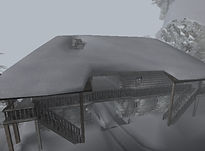
14_SEQ (TEMPLE 1) and 14_SEQ (TEMPLE 2): Has Kirk finally located the entrance to the Hollow Earth and the cult’s TEMPLE, where dark forces threaten humanity? A massive stone doorway, engraved with Sanskrit inscriptions, stands before him. Fortunately, it is slightly ajar. He cautiously slips inside a monumental structure built around a central altar, presumably intended for dark rituals whose true nature remains unknown. As he climbs the steps leading to the top of the structure, he catches sight of a mesmerizing and ominous stained-glass window in the shape of a labyrinthine spiral!
Monumental and Enigmatic Structures


15_SEQ (Unnamed Location): At the risk of his life, Kirk ventures deep into the Earth’s crust, eventually emerging into a gigantic volcanic cavern. Has he stumbled upon archaeological traces of a lost civilization? Megalithic structures emerge from the darkness: a colossal statue reaching both hands toward the void, dizzying bridges, and corridors carved directly into the rock. The doubt quickly fades: humans or supernatural entities shaped these places, but for what purpose? The suffocating heat from the lava flows below irritates his airways. In the distance, on a monumental platform of cyclopean masonry resembling an amphitheater, a cult guardian stands motionless, ready to confront Kirk.
Didier Chanfray: « He was one of the first cult guardians Kirk would have to face, before descending even deeper into the bowels of the Earth and discovering this forgotten civilization, which was waiting for its time to emerge from the depths and conquer the world. »
Journey to the Center of the Earth


How to Explore “8_SEQ (SHEEPEN)”: Here, the prototype loads Kirk below the scene containing the sheep pen. To get back onto solid ground, use the “Free Camera” option in the Debug Menu to locate your position, then move the character to the desired location using the [Direct Teleportation Trick] explained above.
How to Explore “16_SEQ (MINE)”: The mines and their underground lake are difficult to access. A different approach is required, as the player starts this “level” in complete darkness with no points of reference. Open the Debug Menu, select “Log Windows”, and then check the “Camera” box. Next, close the Debug Menu so that the Camera Menu appears. The green squares/rectangles in this new secret window represent different access points to the area, accessible only through the Free Camera. Choose the desired square and activate it so that it turns red, as clearly shown in the photograph below. Exit the Camera Menu using the green cursor so that the prototype can apply the changes to the game. Navigate through the environment using the Free Camera, and you’ll find yourself at the entrance to the mine!
The Descent into the Mine to the Underground Lake, with Its Access Point from the Camera Menu

.jpg)


The Mine and Underground Lake Passage Puzzle Explained (see the cross-section drawing above): Behind the “12_SEQ (MILL 1 or MILL 2)”, clinging to the mountainside, lies another secret entrance leading toward the center of the Earth. Deep inside the mine lies a vast underground lake. An ancient system of locks controls the water level. To have any hope of crossing it by boat and passing through “The Savegame Fault”, Kirk must uncover the secrets and workings of this forgotten mechanism—perhaps repairing, replacing, or correctly aligning its gears. Only by solving this puzzle can he reach “The Meeting Beach” and finally interact with the inhabitants of the “Camp of the Righteous”, who have devoted their lives to fighting evil.
Didier Chanfray: « I had made a cross-section drawing of this lake! In fact, you couldn’t enter through the monumental doorway of the cathedral/temple—that would have been too simple 😊. The hidden entrance was located inside the mill. There would have been a lock-based puzzle to change the level of the underground rivers and gain access to the cave lake by boat. »
The Advantage of the Modified and Playable Video Prototypes: Although the inventory interface is less aesthetically pleasing than the one found in the “E3” Beta, Kirk’s backpack contains a greater number of items. They remain limited in their functionality, however: they can be equipped (although no button is currently assigned to use them, unlike the action button used to fire the weapon in the “E3” version) or examined, as is the case with the now-readable book. The Thompson submachine gun offers a glimpse of the potentially deadly weapons that could have been collected throughout the adventure, while the colonel’s briefcase appears to be connected to the crash site (“2_SEQ (ACCIDENT)”), involving a military convoy swept away by the avalanche. The Video Builds also provide a glimpse of the “Good” / “Evil” alignment system, with meters presumably designed to change according to the player’s moral choices. The real strength of these modified prototypes, however, lies in their ability to let players explore several of the game’s environments, both indoors and outdoors.
The Modified Video Builds in Action
Enjoy exploring, and be sure to visit the chapel at the top of the mountain. The stained-glass textures are magnificent!
Download Links: A Unique Experience
To avoid having to download thousands of different ISOs to play and explore the entirety of Agartha Dreamcast, a compilation has been created bringing together all of the game’s playable prototypes, and even more. Each build complements the others, providing the most complete experience possible. Everything is now gathered together in a single CD-I image.
The compilation’s main menu provides access to the following:
– The “E3” prototype map (“E3 DEMO”)
– The “E3” prototype map in 16:9 format (“E3 DEMO W9”)
– The “official” Agartha trailer (“DEMO”)
– The video prototype featuring all playable “_SEQ” maps (“SEQUENCES”)
– A personal video edit (“BONUS”)

To burn the Agartha compilation onto a blank CD, it is recommended to use the CD-I version with the Dummy file, which improves loading times when running from a CD-R. However, for emulation, the version without the Dummy file works perfectly.
You can download the Agartha Dreamcast compilation below:
The Homemade Cover: A Copy of the Game to Display in Your Collection
Regardless of its level of completion, the discovery of an Unreleased game deserves to be celebrated: to pay tribute to it, give it a second life, and, above all, acknowledge the work of everyone who devoted their time to its creation. With this in mind, Benedikt Scheffer has created a homemade cover for Agartha Dreamcast, ready to be printed at home.


Homemade Cover created by Benedikt Scheffer for Agartha Dreamcast, available to download:
Agartha Dreamcast Homemade Cover
-
Download the Agartha Dreamcast Homemade Cover.
-
To print the cover, open the PDF and select “Actual Size” in the print dialog.
-
The PDF is already formatted to the correct size, allowing you to dress up your copy of the game!
Unmodified Agartha Prototypes and the Katana Development Kit Containing Them: A Matter of Preservation
If you have already downloaded the “Agartha Dreamcast Compilation Volume 2” ISO, the prototypes presented below are intended exclusively for researchers, reverse-engineering enthusiasts, and archaeologists of the Dreamcast Legend. These Beta versions are provided as direct downloads and are made available to the community for preservation purposes, exactly as they were recently discovered.
The E3 Prototype of Agartha (Souvenir Disc)

The Disc Artwork
You can download the hard drive image from the No Cliché Katana Development Kit, containing one of the Agartha Video Builds, below:
You can download the E3 Prototype of Agartha Dreamcast, in CD-I format only, below:
You can download the functional Video Prototype of Agartha Dreamcast discovered in a Katana Development Kit, in GD-I and CD-I formats, below (not playable):

You can also download another partially corrupted version of the Agartha Dreamcast Video Prototype, available in CD-I format only, below:
You can also download another partially corrupted version of the Agartha Dreamcast Video Prototype, available in CD-I format only, below:
Wander through the snow-covered plains of the Romanian countryside to the Temple, where the wind lifts clouds of powdery snow. Crossing the threshold may seal your fate… and that of Kirk and his sister.
Other Articles About Agartha on Dreamcast, No Cliché, and Its Other Games
The Artwork and Concept Art archive provided by Didier Chanfray and Didier Quentin for Agartha on Dreamcast could not be fully covered in this article. Additional pages dedicated to this Survival Horror have therefore been created to shed further light on the game’s preparatory work.
In addition, the investigation into Agartha also led to a deeper exploration of the Hollow Earth theory, the origins of No Cliché, as well as other Dreamcast projects developed by the studio, such as Toy Commander and Toy Racer Dreamcast. Here are all the articles directly or indirectly related to Agartha:

This page traces the history of the French studio No Cliché, from its creation to its Dreamcast productions, highlighting the development of its main projects: Toy Commander, Agartha (Unreleased), and Toy Racer. It explores the studio’s collaboration with SEGA, the creative choices made by the French company, as well as the technical and production challenges it faced. The article draws on developer testimonies, Artworks, and prototypes to illustrate the ambitions behind these games, while also revealing the studio’s inner workings and evolution up until its closure.

This article details the reverse-engineering work carried out on the Dreamcast prototypes of Agartha, explaining the internal structure of the game files—particularly the PAK archives and their indexes—as well as the compression techniques used, including LZSS and its variants. The analysis of the builds also reveals a scripting system used to manage animations, behaviors, and object movement, along with narrative elements such as text and lore. Together, these findings provide an in-depth technical look at the game’s design and the development methods employed by No Cliché.

This article explores the origins and influences of the Hollow Earth theory in relation to the Agartha project on Dreamcast. It examines the esoteric beliefs and mythological accounts describing an underground world inhabited by mysterious beings, often associated with places such as Shamballa and Agartha. Drawing on historical facts, mystical narratives, and cultural influences, the article explores the parallels with the dark and oppressive world envisioned for Agartha.

Explore sketches, Artworks, photos, and level layouts from Agartha on Dreamcast, SEGA’s cancelled Survival Horror. Shared by former No Cliché members Didier Chanfray and Didier Quentin, this conceptual material offers a glimpse into the early stages of the project. Today, these elements allow us to imagine what this promising title might have become, as if the development team had been able to complete the game.
I would like to thank Frédérick Raynal, Didier Chanfray, Didier Quentin and Philippe Vachey for their availability, kindness, and for sharing conceptual material from Agartha on Dreamcast. Their testimonies allow us to rediscover this highly anticipated Unreleased title from the early 2000s from a new perspective and provide a broader understanding of what the game was meant to become.
I would like to thank the entire No Cliché team involved in the studio’s various projects, including Agartha (MobyGames of Toy Commander on Dreamcast).
Acknowledgements:
-
to Sadako Playerone.tv for proofreading and correcting the French text
-
to Neil Riddaway for proofreading and correcting the English version of the article
-
to Benedikt Scheffer for creating the cover Artwork
-
to Frédérick Raynal for making one of the Agartha prototypes available
-
to Benjamin Berget for sharing the game’s menu mock-ups
-
to ShindouGo for creating the ISO containing all the Agartha prototypes
Similar prototypes (Unreleased): Agartha (DC) - Emulateur officiel Megadrive (DC) - Castlevania Resurrection (DC) - Half Life (DC) - Dalforce XOP (DC) - Flinstone (DC) - 4 x 4 Evolution PAL (DC) - Ring : L'Anneau des Nibelungen (DC) - Ecco 2 (DC) - Kyskrew (DC) - Propeller Arena (DC) - Geist Force (DC) - Scud Race Tech Demo Dreamcast - Shenmue 2 US (DC) - The Red Star (XBOX) - Heaven's Drive ( version japonaise de Burnout 1) pour PS2 - Jekyll and Hyde (DC) - The Grinch Jap (DC) - Worms Pinball (DC) - Quake 3 Arena version japonaise (DC) - Vectorman PS2 - Fear Effect Inferno PS2
Feel free to try out [The Dreamcast Unreleased Games to Download] that I found. For the more curious among you, I also wrote [The List of Cancelled Dreamcast Games], which references all of them along with information about each title.
