


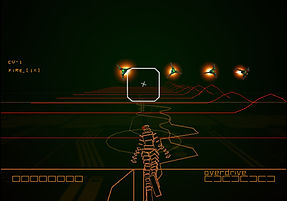
Rez Dreamcast, Its Prototypes and Internal Mini-VHS: When Psychedelic Gaming Came to Consoles
In the late 1990s—a statement that feels even more relevant today—creativity, originality, and boldness in video games were gradually giving way to increasingly formulaic productions. Going against this trend, SEGA was then embracing innovative concepts and experimentation, while giving its creative teams considerable freedom in order to set the Dreamcast’s library apart from those of its competitors.
This philosophy gave rise to several groundbreaking works such as Jet Set Radio, Shenmue, Space Channel 5, and Rez, which is explored in depth in this article. Often misunderstood upon release and achieving only modest commercial success, these titles would nevertheless go on to attain genuine cult status. And if there was one game audiences simply weren’t ready for, it was Rez.
The Rez cover already invites players into another world
Jake Kazdal (Graphic Artists): « We were just excited to do something different, you know, it was very unique, very avant garde, very kind of, you know, fresh, and we didn't wear making for a long time. We kind of, you know, kind of picked at it and tried different things and experimented different things. And it was a lot of experimentation and a lot of time, but we knew we were on to something, and it was just a really fun project to work. »
What can be said about Rez on Dreamcast and PlayStation 2? How can we define this video game UFO, well known among Dreamcast enthusiasts? Few gaming experiences have retained such a strong identity as this musical rail shooter conceived by Tetsuya Mizuguchi. Widely regarded as his most personal project, Rez played a major role in building his reputation over the years and across its many re-releases. Rarely does a game age with such elegance: Rez remains remarkably timeless thanks to its unique wireframe-inspired art direction, almost entirely free of conventional textures.
Jake Kazdal: « What am I most proud of about Rez again? I just think that it's so weird, it's so different, it's so cool, it's so timeless. You know, even now it looks good, like we went so simple with it that it just kind of holds up. »
Strange yet captivating, fascinating and unique, hypnotic and utterly cult, Rez on Dreamcast is one of those games that rarely leaves anyone indifferent. Its bold artistic and sensory approach is as disorienting as it is captivating!
A Stranger Within a Japanese Development Studio
Jake Kazdal, whom we would like to thank for sharing his memories for this article on this iconic Dreamcast-era game, worked on Rez as a Graphic Designer. He was one of the few Westerners who, in the late 1990s, had the opportunity to join a Japanese development studio. He became part of the team at United Game Artists (UGA).
The journey that led him to move to Japan and join Mizuguchi-san’s team is well worth telling, as his hiring at UGA was the result of a remarkable series of circumstances:
Jake Kazdal: I was lucky enough to meet a guy named Kenneth Ibrahim, who had worked at Sega in Japan with Mizuguchi-san on a couple arcade games, including Sega Rally. He was actually the voice for Sega Rally!. He was a instructor at Alias back when we were using Alias Power Animator. And he had come to my studio.
I was working at boss game studios in Seattle, and he came to the studio and was kind of spending time with all the artists, going over some of the new features of the latest the new features of the latest upgrade of the of the 3D modeling software.
And I had been to Japan a handful of times, and had a bunch of Japanese game toys on my desk and a bunch of Sega stuff. And I had just gotten done reading a big Edge magazine article about Tetsuya Mizuguchi. All about him. I was a huge fan of Sega Rally, and he seemed like a really interesting guy.
I Had just literally finished reading about this guy, and sitting there at my desk, and Kenneth looks around, and he's like:
« Wow, you've got a bunch of cool Japanese toys. You've been to Japan a bunch. »
And I said:
« Yeah, I would love to work at Sega someday there. »
It just blurted it out. He's like:
« Oh, I used to work there. In fact, my old boss, Mizuguchi San, is coming to E3 in a couple weeks when you want to meet him, I can hook you up. »
And so he set up the meet, and we met a couple times over that week in Atlanta, 1998 and over dinner, we were talking and just kind of having a good time getting to know each other. And he asked me:
« If I could make any kind of game, what about I want to make? »
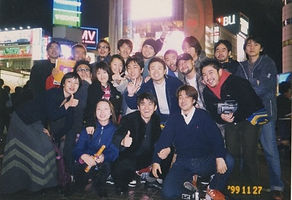
Some period photos of the United Game Artists team, shared by Jake Kazdal

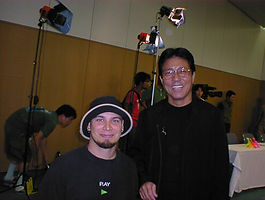
Jake and “Mr. Dreamcast”
And I told him about this, this scene from this movie called Macross Plus, where there's kind of a computer idol, Sharon Apple, who has this really psychedelic concert, really crazy trance music and weird visuals. And it's just like, everything's really stylish and impossibly cool. And I just love that. And I was like, Well, you probably haven't heard of this movie or this animator who I knew did that sequence is called Koji Morimoto, who was the animation director on Akira, and I was just going off about how much I love that thing, and I'd like to make a game like that.
And he's like, wow:
« I'm actually already kind of working on an idea for a music shooter. »
And he kind of briefed me on some of the basics of that.
And he was co owner of an animation studio with Morimoto-san on right down the street from his office at Sega, which was crazy! And so just kind of all the pieces fit into place. And I was just like, oh my god, I have to come work on this. And and I got to meet Morimoto-san too, which was awesome.
And, yeah, it was just kind of a real coincidence. And we were both heading in the same direction, and he was just starting up the new team, and it just seemed like a perfect fit. So I begged and begged, and he hired me.
At the time, a foreigner at a Japanese video was quite rare. I was the only one at my team. There were a couple of other foreigners in some of the different divisions, like AM2 had a guy named Hans who was a programmer for the Virtua Fighter games, and my friend Trevor also was at another division at Sega at the same time. We never met, because they were down kind of headquarters. Sega had their most of the studios down in Haneda, and we were up in Shibuya with am one. And so we kind of, we were pretty separated from most of those guys. So a lot of those guys I only got to meet through other random opportunities, never at work.
It was, it was quite a, quite a, quite an adventure.
The Genesis of the First Musical Shoot ’Em Up
Developed by United Game Artists, a Japanese studio already known for the unconventional rhythm game Space Channel 5 on Dreamcast, also published by SEGA, Rez is a rail shooter. Its gameplay is based on that of Panzer Dragoon on Saturn, which served as the starting point of reference for Tetsuya Mizuguchi, the creator of Rez.
Jake Kazdal: « I think I was pretty lucky to be on that game, and I realized really early on how cool the project was. It like, how special it was that it was so strange and so different, and we were being given the keys to kind of sit around and noodle and make this thing happen. I was constantly, you know, pretty, pretty impressed with it. »
The premise of Rez is simple in appearance, yet remarkably innovative and addictive: the player progresses through the game’s five levels armed with a laser gun, using it to take down creatures and spacecraft. At first glance, Rez does little to reinvent the shoot ’em up, but it is its unique concept that sets it apart. The game cleverly blends shooting and music to create an experience unlike any other. Each target lock and every shot triggers sounds that are layered onto the underlying electronic soundtrack, dynamically altering the game’s music in real time. Gameplay and music thus merge into a true audiovisual symbiosis.
An Incredible Development Studio

Jake Kazdal: « Balance between visuals, audio and gameplay readability. Again, it was just tons and tons and tons of experimentation. We were constantly trying different things, doing little tasks, just kind of working on that for forever and just making it really readable and really minimal really helped. It was a lot more complex early on, and it was a lot harder to actually read and understand. And so by simplifying things, it really was allowing, kind of just the roots of everything, to really show and the clarity really came from that simplicity. »
Rez builds on the work of Wassily Kandinsky, the Russian painter who experienced a perceptual condition known as synesthesia: he could “see” sounds or “hear” colors. His ability to perceive connections between sounds, colors, and shapes became a foundation for the development team’s creative thinking: to create an interactive and sensory experience in which music, colors, gameplay, and art direction would come together as a cohesive whole.
Jake Kazdal: « So really, the code name for the longest time was Kandinsky Project, and we just called it K Project. We went through just, kind of, you know, figured out what we wanted to call it Project Eden, Vibes, Sound Project... We're just kind of trying different things. »
Wassily Kandinsky’s Composition VIII, 1923

The Japanese studio eventually chose to name its game Rez. The name was no coincidence, but the result of lengthy discussions between the members of United Game Artists and Tetsuya Mizuguchi’s friends, Simon Cox and Jason Brooks. They often discussed the film Tron as a reference, particularly its depiction of a digital universe in which programs are disintegrated, erased, or deleted, bursting into showers of light. Fans of the Hollywood blockbuster use the term “derez” (short for “derezolution” or “derezzing”) to describe this phenomenon. Conversely, “rez” evokes the process of creating, loading, or compiling a program. The title Rez therefore emerged quite naturally.
A Unique Art Direction
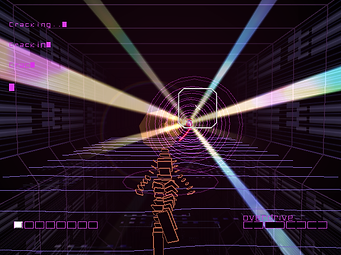
Jake Kazdal: « The terms AAA and triple A weren't really in use yet. What category would you place Rez in today? I would say AA wasn't a big team. It's about 15 of us, maybe, maybe even a I don't know. I mean, it was a small, experimental thing. It wasn't a huge budget, it wasn't a giant project. It was quite small and quite experimental. »
Rez unfolds across five levels—or six if the secret level is included—with each one representing a piece of software within a vast computer system. The player takes on the role of a digital entity whose appearance evolves throughout the game, eventually taking on a humanoid form. The player’s mission is to infiltrate the heart of the network and hack into it, bypassing its defenses in order to reach and free the operating system’s core. In Rez, programs become enemies to be destroyed, the protective layers of the system serve as intermediate stages within each level, and firewalls take on the role of end-of-level bosses.
Rez’s graphics are built around a clean, minimalist, and psychedelic aesthetic. Its visual identity, with its stylized vector-like 3D and wireframe environments, perfectly captures the influence of the 1990s underground techno scene and the cyberpunk atmosphere envisioned by the development team for this true sensory simulator. The whole experience erupts into a dazzling festival of light effects and colors.
Jake Kazdal: « The main inspiration behind the res, minimalist, vector based visual style was actually quite late in development. We tried a couple different styles. We had kind of a urban hip hop style that was really cool. We went with a really kind of like microscopic sea life esthetic for quite a while, which was pretty abstract, was really interesting. »
To achieve Rez’s distinctive visual style, the developers created a proprietary engine, as no existing technology at the time was capable of rendering the lines and shapes required by the project. In reality, the game does not use true vector graphics, but rather convincingly recreates the look through a clever visual illusion.
Rez’s Graphic Experiments on Video
Jake Kazdal: « One night I went out clubbing in Shinjuku, and I saw my first win amp, kind of filters where, you know, these shapes, these, these simple geometric shapes were kind of bouncing and reacting to the music and moving all those around. This is like, you know, 1999 maybe 2000 something like that. And I was like, Oh, my God, that's, that's a perfect fit, like this really minimal thing. And then these shapes can, can really, kind of, you know, resonate with all these visuals. And so I actually had a video camera on me, and I video kit taped this VJ set at this DJ club, and I brought it in to work on Monday morning. And I said, Hey, please take a look at this. I think this is a really promising idea. And he watched it, and he loved it. And then the art team checked it out, and we all were like, Yeah, let's try it. »
No One Was Ready for Rez
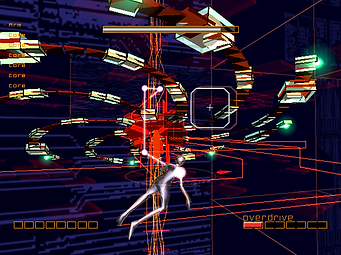
Integrated into the gameplay, the music in Rez does far more than simply set the pace of the action—it is an experience in its own right. Mizuguchi had two talented Sound Designers on his team, Keiichi Sugiyama and Nobuhiko Tanuma, who were responsible for both the technical and creative aspects of the sound engine on which the game was built. They also composed the tracks Buggie Running Beeps 01 and F6 G5. For part of the remaining soundtrack, United Game Artists enlisted some of the most notable names on the international electronic music scene: British artist Adam Freeland, Switzerland’s Mist, and Germany’s Oval. However, among this lineup of guest stars, SEGA chose to put a Japanese artist front and center: Ken Ishii. His compatriot Joujouka (DJ Tsuyoshi) should not be overlooked either.
Jake Kazdal: « The commercials they did were pretty weird and pretty, you know, kind of club culture, which was really cool, because I was really into dancing and clubbing all the time back then. »
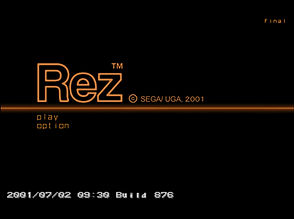
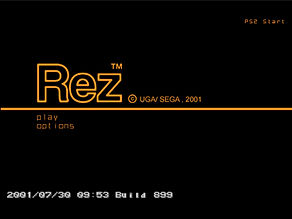
Originally, the earliest Rez prototypes included a track by Underworld, playable in build 876, but the British group ultimately refused to allow their music to appear in the game. Some builds also featured a track by Fatboy Slim, playable in build 899, then one of the rising names of the 1990s Big Beat scene. At the time Rez was in development, Norman Cook, the DJ behind Fatboy Slim, was embroiled in various controversies and significant legal issues surrounding The Rockafeller Skank (1998). To avoid unnecessary controversy, and with the outcome of the legal proceedings involving Norman Cook still uncertain, SEGA ultimately abandoned the planned Fatboy Slim license.
Jake Kazdal: « We also were talking to, was it Apex Twin or somebody? There's a couple other artists we were talking to, and it didn't actually work work out. It was a great soundtrack, still, still classic. »
Whether you’re a fan of techno or not, Rez remains one of the Dreamcast’s essential titles. A single playthrough is enough to grasp its originality and the impact it had on video games, marking a clear before and after Rez.
The Release of Rez on Dreamcast and PlayStation 2
After nearly two years of development, Rez was released in November 2001 on Dreamcast and PlayStation 2, against an especially difficult backdrop for SEGA. The company had just announced that it would discontinue production of its latest home console and withdraw from the hardware business. Despite the bad news, the last faithful followers of the blue hedgehog brand finally got to experience this extraordinary game, which had no real equivalent in the video game landscape of the time.
Cord Smith (Junior Product Manager): « For the Dreamcast versus PS2 comparisons, I definitely remember that we all preferred it on Dreamcast. It was so crisp. A higher frame rate was nice on PS2, but the aliasing made it muddy. »
The back cover of the U.S. PS2 release of Rez
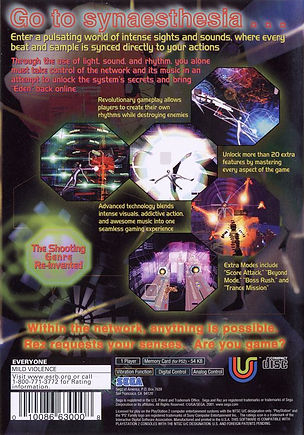
In Japan, United Game Artists’ creation benefited from an advertising campaign clearly aimed at club culture and the electronic music scene. In the West, however, the launch remained relatively low-key. SEGA of America regarded the project as a niche title aimed at a limited audience, with modest sales expectations. The marketing budget allocated outside Japan represented only a fraction of the amount invested in the game’s home market, where Rez originated.
Cord Smith: « No TV, limited digital, and the expectation was it was a curiosity that would appeal to very select gamers as opposed to the masses. I believe America came out fine with regards to sales because they expected them to be low, but in Japan it was considered a failure because the marketing did not generate a hit. »
Writing the product blurb for the back of the box proved challenging for the marketing team. Summing up, in just a few lines, the essence of a game built around synesthesia and musical interaction was no easy task. Cord Smith, then a Junior Product Manager at SEGA of America, whom we thank for his valuable insights into the marketing of Rez, recalls how difficult it was to put the sensations produced by the game into words. In today’s age of animated GIFs and online videos, conveying what made Rez so special would undoubtedly have been much easier.
Cord Smith: « I was, as usual, a bit wording my feature descriptions, but I remember how difficult it was to put Rez into words. It transcends gaming in many ways, but the execs wanted a fairly standard approach to the marketing. Screenshots have never done the game justice. »
Before taking a detailed look at the Rez Dreamcast prototypes and its mini-VHS, let’s give the final word to Cord. In just a few words, he perfectly sums up the essence of this unconventional creation by Tetsuya Mizuguchi and his team:
« But that’s the beautiful thing about Rez: it was never conceived to be a hit. It was an art experiment fused with sound that shouldn’t have even been made, but that team created magic and it exists, and gaming is better for it. »
The Debug Menu: Experience Rez Like the UGA Developers
The Dreamcast prototypes of Rez available for download below, The Fatboy Slim Build and The Underworld Build, each include a Debug Menu. Beta build #775, recovered from the mini-VHS, also contains one.
For an unknown reason, the developers at United Game Artists disabled this feature when burning the confidential red GD-ROMs. Activating it therefore requires modifying the game data.
To access the Debug Menu, the method used to reactivate it works exclusively with Flycast. Simply download the files corresponding to each beta below, then inject them into Rez after launching the game via the Cheats Menu in the Dreamcast emulator.
The Rez Debug Menu is remarkably extensive. Similar in structure to the one found in Space Channel 5, it allows developers to modify and test a wide range of parameters and features in real time: Free Camera, changing enemy positions, unlocking all levels, accessing test maps, and much more.
To develop this tool, the United Game Artists team built upon Nindows, a debugging interface provided with the Ninja library from the Dreamcast SDK, adapting and customizing it to meet their needs under the name Gindows.
The Rez Debug Menu is not the most intuitive tool to navigate. Here is a guide to its most interesting options:
Controls (with a keyboard connected to Port D):
F1: Performance window
F2: Memory window
F3: Mainflow editor (during gameplay only)
F4: GameInfo window
F5: Camera window
F6: Image stabilizer On/Off
F7: Variable editor
F8: Free Camera
F9: System window
F11: Resets Mainflow, Passflow, and Gameflow
F12: Shows/Hides Debug Mode
Alt + F11: Loads the next stage (in-game only)
Print Screen: Debug information
Scroll Lock: Advances one frame when the game is paused
Pause/Break: Pauses the game
Alt + Tab: Switches windows
Ctrl + 1: Automatic stabilizer 1 (smoothest, heaviest performance impact)
Ctrl + 2: Automatic stabilizer 2
Ctrl + 3: Automatic stabilizer 3
Ctrl + 4: Automatic stabilizer 4
Ctrl + 5: Automatic stabilizer 5 (skips frames, lightest performance impact)
P (in the level selector): Unlocks all levels
F1 : Performance

F3 : MainFlow

Free Camera (with the controller connected to Port A)
L+R: Select the movement speed from four options (0.1 / 1.0 / 10.0 / 100.0)
Joystick: Rotate the map clockwise/counterclockwise
A: Move the camera down along a lateral axis
X: Move the camera up along a lateral axis
B: Rotate downward around a fixed point
Y: Rotate upward around a fixed point
D-Pad Haut: Move forward
D-Pad Bas: Move backward
D-Pad Gauche: Move left
D-Pad Droite: Move right
Free Camera

Miscellaneous
A button on the controller connected to Port B — SEQUENCE: Access different sections of the game, such as the Score Attack menu, level selector, Game Over screen, SEGA logo, and more.
A button on the controller connected to Port B — MODULE: Similar to “Sequence,” with a few differences.
A button on the controller connected to Port B — STAGE: Start directly at the desired level (01/02/03/04/05/06/20/21/22/23/50). Warning: Selecting “50” crashes the game.
B button on the controller connected to Port B: View Rez textures, system information, and more.
Debug Menu 1 (key A)

Debug Menu 1 (key A)

Debug Menu 2 (key B)

There are, of course, many other keyboard shortcuts, particularly for configuring enemy placement or altering the sequence of events within a level through the Mainflow Menu/Editor. At this point, however, we move into much more complex aspects of the Debug Menu.
Explore, experiment, and familiarize yourself with the many possibilities offered by the Rez Debug Menu.
The April 19, 2001 Rez Dreamcast Prototype on Video (Mini-VHS)
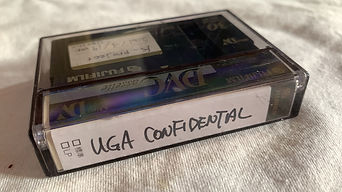
SEGA recorded raw footage of its games on digital tapes, including the MiniDV format. Introduced in 1995, this technology stored video on small digital cassettes with a low compression rate, making it easier to transfer the footage to a computer for editing. These recordings were then used to produce commercials, trailers, presentation videos, and various other promotional materials.
The video below showcases a Rez Dreamcast prototype dated April 19, 2001. This version 0.10, identified as build #775 within United Game Artists, is currently the oldest build available for download or viewable in a video of sufficient quality. Unlike other Rez video captures that have survived over the years, this one has the advantage of relatively clean footage and a substantial runtime of 10 minutes and 39 seconds. This makes it possible to analyze this beta in detail, despite the fact that it cannot be played directly.
K Project UGA CONFIDENTIAL: Digitizing the Rez Dreamcast MiniDV (April 19, 2001 Prototype)
This prototype features several graphical assets that were ultimately abandoned during development, although traces of them can still be found in the files of later versions of Rez. Their presence had intrigued Rez enthusiasts for years. This video finally reveals what they were originally used for.
The level selector already features an early visual identity. This interface would be progressively refined throughout the development of Rez. However, the developers retained this initial approach and later used it as the basis for designing the Score Attack Menu.
Rare internal Rez Mini-VHS
The character’s initial form features a more rudimentary animation than in the final version: it does not lean when aiming sideways, and its wireframe geometry reveals several imperfections.
Some of the level’s textures also differ. At the beginning of the level, several large yellow folders scattered across the floor oddly display the words “Play Sound & Survive” on their covers.
When activating an Overdrive, which allows the player to automatically fire at enemies, the targeting indicator is accompanied by a distinctive visual effect that would later be removed.
During its second phase, the Earth boss features a bright green finish instead of the silver-bronze appearance adopted later. Destroying the level’s boss is not yet accompanied by the familiar electric explosion sound effect. Instead, the game triggers a more rudimentary sound named “EAR_DEAD”, which was ultimately discarded when Rez went GOLD.
The “Support Items” displayed on the score screen are still referred to as “Coprocessor”. The visual design of this screen is also still at an early stage of development.
All that remains now is to track down a long, high-quality video recording—or, better yet, a playable prototype—from a period when the game’s core was not yet finalized and United Game Artists was still experimenting with new ideas.
Rez Prototypes with Dedicated Pages
Several other prototypes of Tetsuya Mizuguchi’s game accompany the mini-VHS and the making-of of Rez discussed above. These intermediate development builds feature a number of unique elements that are worthy of dedicated articles in their own right. How could one not be intrigued by the Underworld and Fatboy Slim tracks that were removed before the game’s release, when these builds actually allow you to listen to and play with them?
Rez Prototypes Available for Direct Download
These Rez builds are very close to the final version and do not feature enough significant differences to warrant a detailed analysis. They are nevertheless available for direct download below:
.png)
Rez (Sep 30, 2001 Dreamcast Prototype)
Important:
I am unable to share the ISO of the September 30, 2001 prototype at this time, although that may change in the future. I can, however, discuss it and show you photographs of it.
I would like to warmly thank everyone who, directly or indirectly, contributed to the development and history of Rez on Dreamcast and PlayStation 2 for their availability and kindness, including Cord Smith and Jake Kazdal, with whom I had the pleasure of speaking. Their memories allow us to travel back in time to the development of Rez and gain a better understanding of the circumstances, choices, and ideas that shaped the game.
Acknowledgments:
-
to Joris "CDi" Lelong for proofreading and correcting the French text
-
to Woof for the English translation of the article
-
to KailoKyra and Jansky for digitizing the MiniDV
-
to Woof for investigating the Rez Dreamcast prototype and helping analyze it
Really special prototypes (big differences, early Builds, weird ones, etc.): Guilty Gear X (DC) - Dead or Alive 2 (DC) - Samba De Amigo (DC) - Virtual-On Oratorio Tangram (DC) - Spirit of Speed 1937 (DC) - Re-Volt (DC) - Phantasy Star Online (DC) - San Francisco Rush 2049 (DC) - Evil Twin: Cyprien's Chronicles (DC) - Toy Racer (DC) - Space Channel 5 (DC) - Sega Smash Pack Vol.1 (DC) - Red Dog (DC) - Propeller Arena (DC) - Half-Life (DC) - Jet Set Radio (DC) - Daytona USA 2001 (DC) - Floigan Bros. Episode 1 (DC) - NBA 2K1 (DC) - NFL 2K1 (DC) - NHL 2K (DC) - World Serie Baseball 2K2 (DC) - Rez The Fatboy Slim Build (DC) - Rez The Undercower Build (DC)
More than 300 prototypes have been digitized. You will find them available for free download in the section: [Dreamcast prototypes (and more) available for download]
