


Crazy Taxi and its prototypes: in the shoes of colorful Taxi drivers
Hey hey! Come over and have some fun with Crazy Taxi! Which Dreamcast gamer doesn't recognize this iconic phrase and the voice of the announcer who utters it? Crazy Taxi Dreamcast (CT1), like Sonic Adventure, Shenmue and Skies of Arcadia, is a must-have for SEGA's spiral console. It's not for nothing that Hitmaker's crazy, crazy, crazy game joined the elite circle of million-selling games, with total sales approaching 1.1 million copies sold.
Bryan Burton-Lewis voice (dubbing actor) on screen title
The idea for Crazy Taxi was born in the studios of AM3, a division of SEGA specializing in arcade games. AM3 was renamed Hitmaker in 2000. Kenji Kanno, Crazy Taxi's co-producer and director, wanted to create a racing game that would stand out from the crowd, emphasizing freedom of movement, fluidity and speed. He and his team aimed to deliver a fast-paced, intense driving experience, where players would feel an adrenaline rush as they transport passengers through a dynamic, interactive urban world. And they succeeded!
This title screen...

Launched in 1999 on the Naomi arcade board, Crazy Taxi's energetic gameplay, catchy soundtrack featuring bands such as The Offspring and Bad Religion, and its open world made it an instant hit. To capitalize on the game's popularity, SEGA ported it to its latest console, the Dreamcast. This meant that anyone could play this crazy new license from the comfort of their own home.
Do some Vroom for the immortal Crazy Taxi

The soundtrack, carefully chosen by Hitmaker (AM3), helped give Crazy Taxi a unique identity, deeply rooted in the popular culture of the time and even today. When you think of CT1, you automatically think of The Offspring, the Californian punk band formed by Bryan “Dexter” Holland. This soundtrack kicks ass - we couldn't have wished for anything better.
Axel proudly poses for the camera

For the Dreamcast release, Kenji Kanno aimed for more than a simple port of his game. New content was added, including the Crazy Box with its crazy challenges and the option to explore an alternate version of the city via the Original mode.
In order to accentuate the game's realism while retaining its fun factor, a balance that was difficult to strike, SEGA obtained licenses for brands such as KFC, Pizza Hut, Tower Records and FILA. Crazy Taxi became one of the first titles to showcase advertising in-game in a prominent way. For finding your direction in the city, these points of interest are perfect and easy to memorize.
In Crazy Taxi, the player must pick up passengers scattered around a fictional city and drive them to their destination as quickly as possible. The price they pay depends on the speed of the trip. The fun is immediate, thanks to a simple principle and controls. What's more, a Scoring system adds to the game's fun, pushing players to outdo themselves and take more and more risks. Performing stunts such as jumps and skids, or narrowly avoiding other vehicles, earns bonus points in the form of tips. The aim is to “scare” the passengers - their animations and expressions are funny when they're scared - and earn as much money as possible before the time runs out.
Crazy Taxi (1999) was among the first open-world racing games, alongside titles like Midtown Madness (1999), Driver (1999), Carmageddon (1997), and the Unreleased Dreamcast games Felony Pursuit (1999/2000) and World's Scariest Police Chases: Deadly Pursuit (1999/2000). These games were either released or planned for launch around the same time. For CT1, the developers drew inspiration from San Francisco to create its vibrant megalopolis, complete with iconic landmarks like shopping malls, parks, and train stations. Mastering the game hinges on learning the city's streets and shortcuts.
The brave and valiant Taxi drivers

Since its release, Crazy Taxi has become a cornerstone of the retrogaming scene and is often hailed as one of the Dreamcast's best titles. It spawned sequels, including Crazy Taxi 2 DC (an alternate version of the game, to be discovered here), and was adapted for PlayStation 2, GameCube, Xbox, and PC. In 2021, SEGA even announced plans to revisit its famous Taxi franchise. Wait and see!
Axel, B.D. Joe, Gena and Gus, the four cab drivers, were born with a steering wheel in their hands and a gas pedal glued to their feet. They are the eagles of the road. They roam this chaotic city in search of the best of themselves and the best of us!
Classified : Carbondale the Survival Horror from Hitmaker
Hitmaker, originally known as SEGA AM3, was one of the blue hedgehog company's jewels in the crown. This internationally renowned studio had a long history of arcade and console game development. AM3/Hitmaker is the perfect example of SEGA's ingenuity in bringing arcade games to home consoles. Crazy Taxi Dreamcast is proof of this.

During the 1990s, SEGA divided its in-house development studios into several teams, such as AM2 (Shenmue, Propeller Arena) and AM1 (Wow Entertainment from 2000 with games like SEGA GT and House of the Dead 2), to foster innovation and specialization. AM3, on the other hand, focused on immersive, accessible experiences. Their games were primarily aimed at a broad audience, whether sports or action fans.
Virtua Tennis

In 2000, SEGA reorganized its internal divisions into semi-independent studios to stimulate creativity and respond to market changes. AM3 was renamed Hitmaker. The studio continued to work on major titles while retaining its reputation and know-how as an arcade game designer.
Hitmaker, prolific between 2000 and 2004, had developed games for Dreamcast, not to mention those for other consoles, such as Virtua Tennis (2000), Virtua Athlete 2K (2000), Crazy Taxi (2000), Crazy Taxi 2 (2001), Virtua Tennis 2 (2001), Segagaga (2001) and Confidential Mission (2001). Some of them are still cited today as references in the genre.
This article dedicated to Crazy Taxi Dreamcast is the right place to talk about an aborted Hitmaker project. What nobody seems to know is that this Japanese studio was designing a horrific game in the greatest secrecy. Unfortunately, little information has been leaked about it.
Following the success of their Dreamcast games, in particular Crazy Taxi and Virtua Tennis, the Hitmaker team had tried their hand at a genre new to them, Survival Horror. The developers were stepping out of their comfort zone, given that the Japanese development studio was mainly focused on arcade games.
The Carbondale police station

The game, planned for PlayStation 2, Xbox and possibly even Dreamcast, was SEGA's answer to Capcom's Resident Evil. It was called Project H before being renamed Carbondale. The name change followed a scouting trip to the town of Carbondale in the U.S. state of Illinois.
At a time when the term Urbex (Urban Explorer) didn't yet exist, Hitmaker members, equipped with high-end capture equipment, had visited game-relevant sites throughout the town of Carbondale. These included the police station and its armory, the shopping mall and its security corridors, the water treatment plant, a recently built hospital, an abandoned high school and they even had access to the city's underground tunnel system. Meticulously chosen locations to immerse themselves in, and later reproduce, the claustrophobia and oppressive atmosphere of their future title.
Even though they have fond memories of their trip to America, they didn't get the green light to continue development of their Survival Horror after a first prototype was presented to SEGA.
These days, only photos of their road trip exist. Too personal to be shown, they would need the permission of Hitmaker members to be shared. At SEGA of America, a privileged few were able to see a video of Carbondale in action. This video and the game prototype are now considered lost.
In 2024, the abandoned high school has still not been demolished

What would this survival horror from the kings of the arcade have looked like? What would have been its catchy concept to set it apart from other games in the genre? Its artistic direction? These are the questions that everyone is asking...
Crazy Taxi prototype dated October 30, 1999
Analysis of the prototype reveals that the build was created on October 30, 1999 at 04:22:37. This early Crazy Taxi Dreamcast beta was burned about 1 months before the final version on December 19, 1999, and 14 days before the most interesting prototype on this CT1 page (November 14 at 05:49:29). This beta of Hitmaker's game is, in a way, an alternative version opening up new possibilities/functions to players, thanks in particular to its never-before-seen views!
An oddity of the devs

What happened to “Presented by”?

1999 or 2000, it doesn't matter, no one will notice the difference

To bug, Attract Mode bugs

The trailer for the October and November 1999 prototypes
Please note that this particular CT1 build takes some time to load, between 3 and 5 minutes. Be patient and don't expect the game to crash. Before doing so, the prototype passes through several intermediate stages with black windows on which the following messages can be read: “Loading Crazy Taxi (15 k)”, “Setup Data C1”, “C2” and finally “C3”. Yet another oddity in the land of prototypes!
The pixelated Crazy Taxi motif on the Dreamcast memory card is not animated. The prototype requires 16 free blocks on the VMS to save a game, instead of the normal 23. Saves from the final version of the game are compatible with this build, but not vice versa. In fact, loading a game with saves from the final version is the only solution for accessing certain events in “Crazy Box” mode.
At launch, the SEGA logo is slightly different, without the “Presented by” inscription, from that of the final version, and the screen introducing ADX, the proprietary lossy audio storage and compression format used to design Crazy Taxi, is not yet present. The blue hedgehog's trademark can also be seen at the end of Attract Mode. Some call it Demo Mode (the cutscene introducing the title screen without pressing any buttons).
The title screen shows “© Sega 1999” instead of “© Sega Enterprises, LTD, 1999,2000”.
The introductory cutscene, the title screen demo, looks more like Crazy Taxi Arcade than Hitmaker's Dreamcast port. It's buggy, with cabs driving through parts of the city that aren't yet loaded when they should be. At the end of the cinematic, the announcer's voice-over encourages players to put coins in the arcade machine, instead of asking them to press the START button, as is normally the case with the console version of the game.
Cab drivers don't yet have their own animations before the start of a game. Life in this version of Crazy Taxi is bleak!
The time saved by collecting customers and bringing them to their destination is much less generous. It's much harder to play the game for sessions as long as those in the final version.
The menu navigation sound effect is quieter than usual. The audio used to exit a menu or go back is that of the vehicle skidding, not that of clutch/acceleration.
The 4 licensed songs that accompany the player during a game have different mute/transition points. Pausing the game does not reduce the music volume.
The physics are far more problematic than in the Arcade or final versions: it's much easier to perform the “Wall Stick” glitch, even by accident, and it's harder to get “unstuck” from the wall.
During a game, no text appears on the screen to warn, for example, that the player has to take customers or that he's going the wrong way.
Unlockable bikes, additional vehicles, are not implemented in Arcade and Original modes. They can only be ridden in Crazy Box challenges after loading a full save from a final version.
This chapter sets the scene for what's to come, but it's not over yet. Like a movie, save the best for last!
The menus
In the “Option” menu, the prototype offers the possibility of setting the start time (Time Setting) between 40 and 70 in increments of 10, unlike the final version, which offers a choice between 35 and 70 in steps of 5. The layout is slightly different, with red squares instead of blue. The final version offers the sub-options “Music Volume” and “Controller Setting”, whereas the prototype calls them “BGM Volume” and “Device Setting”.
The prototype

The Final Version

While there are 3 controller presets (A - B - C) in “Device Setting”, nothing happens when you try to validate the second and third Pad configurations.
Debug informations

"Records” submenus are empty. No results have yet been registered or shown. The developers had not yet begun work on this aspect of the game.


A - B - C, always the same control scheme

This build of Crazy Taxi on Dreamcast displays Debug information when the game asks you to enter a name in Crazy Box game mode or in the “Save and Load” option.
Like the credits of a feature film, the analysis of menus from one version to the next is not the most exciting thing to read. Documenting a prototype involves this obligatory process.
The Arcade mode
Once Arcade or Original mode has been selected, rather than playing “Play by Arcade Rules”, the prototype suggests launching a “Rule of Arcade” game. This build offers longer sessions of 5, 10 or 15 minutes instead of the familiar 3, 5 and 10 minutes.
A rough neighborhood with graffiti

In-game, there are many faulty or poorly applied textures and lighting throughout the map. Many buildings have textures with explanatory text scrawled in red saying 使っちゃダメ (Do not use).
Although the Original Levi's boutique is an address where customers can visit, and the preview box for this destination shows it to be fully textured, the building itself in the game is almost entirely devoid of textures. It's the only licensed building in the prototype to exhibit this characteristic. Strangely, however, its textures seem to load correctly during the introductory cutscene.
The sailboats in the marina have no textures whatsoever. They are simply white, perhaps due to the Greyboxing method used in video game programming. This problem of temporary white textures is repeated regularly, as with the sign in front of the FILA store.
Axel has to buy new jeans, his are outdated.


A lovely view of the marina


Jeans or sportswear, which will he choose?


A little ramping up of power before the final climax, just a little more patience. All good things come to those who wait.
The Original mode
All the new destinations on the original map are either represented by generic buildings, vacant, lacking detail, or are completely empty. However, their locations have already been implemented. For example, the Millennium Tower, though absent, is still available to customers. In this build, it is temporarily represented by the Kentucky Fried Chicken building. The street leading to it already exists but is surrounded by a wall halfway along, and the player has to park his car in front of it to drop off the customer.
The city in Original mode is virtually the same as in the final version, the only difference being that there is a third ramp next to the cafeteria and a fourth on the other side, allowing the player to reach the roof, which is normally only accessible via the ramps between the Millennium Tower street and the Park. The collision system is deactivated on certain downtown ramps.
CT1's fictional San Francisco is decorated in a very diverse and varied way: some areas are identical to those in the final version, others are dressed very generically or with blurred textures, and many parts of downtown are completely devoid of anything other than roads.
The player's starting point is very slightly different. All destinations use the city indexes and preview images from Arcade mode. Each customer to be picked up by your Taxi is the same placeholder female model.
The green direction arrow, a game mechanic patented by SEGA in 1997, is only partially functional. It only indicates the destination, instead of also trying to guide the driver through the city's neighborhoods.
The trains, when incorporated into the prototype, are scattered around the city in the most unlikely places, making for some hilarious encounters!
More time to visit the city

Trains are possessed!

Significant slowdown affects the gameplay experience in Original mode, much more than usual. The game was not yet optimized at the time of this build.
Greyboxing in Original mode


A world of oddities


It's too much


Crazy Taxi in a parallel reality


Blurred textures are not due to the effects of a drug


Yeah, yeah, yeah, a big jump


Unfortunately, the highlight of the show isn't quite there yet. The main meal has to be eaten before dessert.
The Crazy Box mode
Once a Crazy Box event has been successfully completed, it is not marked as finished. High scores for this and other game modes have not yet been integrated into the prototype. As a result, only the first 9 levels of Crazy Box are accessible without the need for a final version save, as explained above.
All the challenges have the same objectives as in the final version, with more or less complete zones. No rules have been written for any of the 16 stages, in the black box below the word “RULE”. At the start of a race, the message “Ready Set” is displayed instead of “Ready”?
The challenges
1-S (Crazy Bowling) : When hitting the bowling skittle, no sound is produced. The announcer, the voice-over, is silent during this event in the prototype.
3-S (Crazy Zigzag 2) : Strangely, all stops are marked as “Yacht Harbor”. The time limit is ridiculous - 35 seconds, not 40. As the 2-S (Crazy Zigzag) map has been reused, it retains all the special features mentioned in that challenge.
1-1 (Crazy Jump) : The time allowed to complete the event is 1 minute and 40 seconds. In the final version, there is no timer. The event takes place in a completely different location, a sort of glass bridge over the ocean instead of the dome in the final version. The player, by jumping sideways and being fast enough, can go off the road and fall into the void after landing his jump. The camera starts below the vehicle. In the final version, it doesn't snow, unlike this prototype, which takes place in winter.


3-3 (Crazy Pole) : All the customers on this level are the same; the man with the bouquet of flowers. The map is less elaborate than usual. The system for picking up customers as the previous one leaves, which is exclusive to this mission, is already operational. Neither the cab driver nor the new customer are as silent as they should be. Their destination is displayed in a preview box and appears as follows: Cable Car Stop TOP, Sail st., Fresthree st., Cable Car Stop BOTTOM, Seaside Market, West side beach, Yacht harbor and Cafeteria. The woman in front of the church at the last stop repeats the animation of Axel jumping into the cab at the start of Arcade or Original mode, ironically unused in this build. Usually, she remains motionless. The man with the bouquet of flowers, the last customer, doesn't animate when he touches her; he just turns on the spot.


2-1 (Crazy Drift) : The customer differs from the final version and asks to go to the Cable Car Stop TOP 10.16 km away (destination preview box). Set elements such as the grandstand and hot-air balloons are not yet included.


2-2 (Crazy Turn) : The time allowed to complete the challenge is an unreasonable 30 seconds. In the final version, the timer says 35 seconds. The customer, a different model to the one used later, complains of almost being run over. The area's environment is devoid of detail, with fences replacing walls and no buildings on the right.


2-3 (Crazy Bound) : There are no arrows on the ramps to indicate which direction to take. In the final version, the developers will add a wall around the sixth platform to prevent direct access from the fourth, as the space between them is relatively small. The green-highlighted area where the cab can be parked to complete the mission is tiny compared to the known one.


S-1 (Crazy Thru) : The customer doesn't look like the one in the final version and asks to go to the Car stop TOP cable 1.39 km away. At the halfway point, the road is devoid of textures to indicate that it is dented. However, the driving effects can already be felt on this section of asphalt. The scenery elements on the sides of the track are slightly at odds with those applied in the final version.


S-S (Crazy Attack) : The customer, who is not the Punk of the final version, asks to be taken to the cafeteria 0 m away. The indicator of the time already elapsed when passing through a Checkpoint is distinctly displayed. The voice-over does not announce that a Checkpoint has just been passed. The announcer constantly reminds the player that he's going the wrong way, presumably because the destination is just behind the start zone. The proof is that the announcer stops complaining halfway through the event.


1-2 (Crazy Flag) : The flag showing the arrival of the challenge is not a flag in this prototype, but a little yellow star. How cute...


3-1 (Crazy Proposal) : The challenge is called “Crazy Proposal” rather than “Crazy Rush”. All the customers are the same (the man with the bouquet of flowers) instead of a variety of male models. The background outside the playable area doesn't yet exist, nor do destructible elements on the playing field.


1-3 (Crazy Balloons) : The time allowed to complete the challenge is 40 seconds instead of 45, and there is no sound when a balloon bursts. The background outside the playable area, based on the city in Original mode, is not present.


S-2 (Crazy Parking) : Compared with the released version, the customer's appearance has changed. Strangely enough, he's one of the few people in the prototype's Crazy Box mode who doesn't ask to go to a specific destination. In the final version, no passenger in this game mode asks the driver to go to a particular place. The exterior of the parking structure is different.

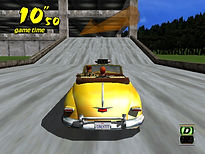
2-S (Crazy Zigzag) : The challenge's scenery lacks detail. The ocean floor will be lowered when the game is moved to GOLD. The customer's model is, once again, not the one normally used. As in challenge 2-3, the green highlighted area for parking the vehicle is abnormally small. This feature is also repeated in 3-S (Crazy Zigzag 2).


S-3 (Crazy Party) : The customer, several meters behind the point where the cab appears in the level, is not surrounded by any parked cars. Not a single bowling pin is placed on the road leading to the top of the mound to the left of the event's starting point. The level designers had yet to place fences and other destructible elements on the flat top.


3-2 (Crazy Jam) : The time limit is set at 40 seconds, slightly less lenient than the 45 seconds of the final version. The three customers are different from those in the commercially released game, and all share the same model. They ask to go to the Cable Car stop TOP, Sail ST. and Freshtree ST (view box). The area's scenery is oddly highlighted with extremely blurred, stretched textures often on generic buildings.


Abracadabra, the last part of the film has finally arrived with a masterful punchline. Just a few more paragraphs to go before we get to the bottom of the story.
The alternative version of Crazy Taxi
A video game prototype is rarely intended to be played. It does not reflect the finished product as it will be released commercially. Understanding its development remains its main interest. Sometimes, content deleted during the design of a video game is hidden in the bowels of beta files, or even on the screen with a controller in hand. When this happens, the in-game experience can change dramatically. Such is the case with this early version of Crazy Taxi Dreamcast.
The charm of this build of Crazy Taxi Dreamcast, despite all its bugs and optimization problems - its development was far from complete - lies in the content that was cut when it went GOLD. The developers undoubtedly used it to record the game's trailers and take screenshots. This prototype offers players the chance to drive a cab from new angles, thanks to never-before-seen views.
In addition to the Hitmaker title's standard default view, 7 new cameras are incorporated into the game, including some fun ones. The “Y” button on the controller plugged into the console's “A” port is used to switch from one view to another, both in-game and during Attract Mode. Normally, this button is assigned to the horn. Here they are, in order:
View 1: Standard, by default

View 4: Static aerial view
View 2: Slightly elevated

View 5: From the side of the vehicle
View 3: Grand Theft Auto like 1

View 6: Facing the car


View 7: Replay

View 8: Black screen

The eighth view on a black screen is useless. Either it is placed there as a landmark announcing the end of the scrolling of the 8 different cameras, or it opens up new, as yet undiscovered Debug options, to be explored further...
Once a view has been selected, the angle and orientation of the camera can be adjusted to the player's liking by means of additional manipulations. Here are some tips on how to do this with a controller plugged into the Dreamcast's “D” port:
Button “A”: Freeze / Unfreeze the game
Press and hold Button “A” without freezing the game: Zoom in on the vehicle up to the Taxi's dashboard, the camera's dive angle is not adjustable (does not work with views 1, 4, 7 and 8).
Press and hold Button “B” without freezing the game: Zoom out from the vehicle at will, the camera's move-away angle is not adjustable (does not work with views 1, 4, 7 and 8).
Les directions du "D-Pad" : Turn the camera around the Taxi (works only with views 5 and 6).
The "Free Camera", ideal for...

The second aerial view with a fixed camera, number 4, is dedicated to activating the “Free Camera” option. The “D-Pad” arrows on the fourth controller are used to orient the camera in the desired direction, while the “Left” and “Right” triggers are used to move forwards and backwards. A great opportunity to visit/explore the city without getting stuck in traffic!
Crazy Taxi 2 and its cameras

Logically, given the goal the developers had in mind with this camera system, a button combo that erases the HUD (user interface) should be present. If it exists, it has yet to be found...
During the development of Crazy Taxi 2 for Dreamcast, as shown in the March 11, 2001 build, Hitmaker's programmers reused the camera system from Crazy Taxi 1. This time, it's more advanced and flexible, reflecting an evolution in the developers' approach. As a hidden bonus, some cameras were retained in the final version of CT2, though they are more limited compared to those in the game's View Debug Menu.
The excursion into this Crazy Taxi Dreamcast prototype ends on a high note with these few words. Crazy Taxi Bros, the film and TV production and distribution company, will be offering new films in the future!
Special thanks to FamilyTeamGaming for its expertise and invaluable help in documenting this Crazy Taxi Dreamcast prototype.

You can download this build of Crazy Taxi Dreamcast below
Crazy Taxi prototypes with a dedicated page
These Crazy Taxi prototypes are very special. That's why a dedicated page is devoted to them, detailing their features (a build analysis).
_20250121_0001.png)
You can download this build of Crazy Taxi Dreamcast below:
Warning:
The November 1999 prototype is the ultimate MUST HAVE version of Crazy Taxi Dreamcast. Close to the commercially available game, the differences are minimal. This beta corrects the defects noted in the October 1999 build, while still offering the functionality of angle of view management among 7 brand-new cameras.
Other Crazy Taxi prototypes available for direct download

Special thanks to:
-
Hicks for proof-reading the French text
-
Neil Riddaway for the English correction of the article
-
FamilyTeamGaming for investigating the Crazy Taxi Dreamcast prototype and helping to analyze it
Prototypes with special options (Cheat, Free Camera etc.): Crazy Taxi Dreamcast - Nigthmare Creature II Dreamcast - Sega Extreme Sports Dreamcast - Gauntlet Legends Dreamcast - South Park Rally Dreamcast - Ecco the Dolphin: Defender of the Future Dreamcast - Fur Figthers Dreamcast - Hydro Thunder Dreamcast - Le Mans 24 Hours Dreamcast - Draconus: Cult of the Wyrm - Metropolis Street Racer - Crazy Taxi 2 Dreamcast - Rayman 2 Dreamcast
More than 300 prototypes have been dumped, all of which are available for free download in the section “Dreamcast prototypes (not only) available to download”.
