


Exploring the Charm of the Dreamcast VMU: From Design to Release, Including Its SDK and Dedicated Memory Card Utility
In the history of video games, few consoles have left as lasting an impact as the Dreamcast. Released in 1998, this groundbreaking system redefined the gaming experience by pushing the boundaries of interactive entertainment. At the heart of this innovation was the Visual Memory Unit (VMU), a storage device that went far beyond the role of traditional memory cards.
This small module, designed to be inserted directly into the controller, allowed players to save their progress while also featuring an LCD screen and dedicated buttons. Also known as the VMS (Visual Memory System), the VMU gave players access to standalone mini-games, creating the illusion of a true extension of the gaming experience beyond the television and the console. This innovative approach transformed simple save data into a fully-fledged gameplay experience in its own right!
Despite SEGA’s strong encouragement for developers to make full use of this peripheral, few productions truly took advantage of it. Tight deadlines, limited budgets, and the demands of multi-platform development led many publishers and studios to restrict the VMU to the role of a standard memory card.
The promotion of the VMU in the Dreamcast press kits

The premature end of the Dreamcast also curtailed the potential for further exploration of the Visual Memory Unit, just as some SEGA teams and programmers were beginning to fully grasp its capabilities. Agartha on Dreamcast,for its part, planned to include a mini-game stored directly on the memory card that would be mandatory to progress through the adventure—a first of its kind for this survival horror title by Frédérick Raynal, whereas in other games such features remained entirely optional for advancing the main storyline. Several other projects, now largely forgotten, little-known, or left unfinished, perfectly illustrate the full range of possibilities offered by the VMS:
-
Godzilla VMU: Even before the Dreamcast was released in Japan, SEGA offered a limited-edition VMU featuring the built-in mini-game Atsumete Godzilla: Kaijuu Dai Shuugou. It played like a monster-raising/management game in the vein of a Tamagotchi. The player is given a baby Godzilla to raise directly on the memory card. The idea was to have it battle those of other players via connected VMUs and to win new creatures that could then be used in Godzilla Generations.
-
VMU Football: The first mini-game designed specifically for the VMU, independent from any main game, to be made available for download via the console’s network in September 1999. This title was developed using code by Alexander Villigran. Inspired by and based on the LED handheld game Mattel Football, it stood out thanks to its first-person perspective—an unusual and impressive choice given the extremely limited screen size of the Dreamcast memory card.
-
Dreamcast VMU RPG: Within SEGA of America, Alex Villigran stood out for programming mini-games for the Dreamcast memory card. Building on the mini-game from Time Stalkers (Climax Landers), he undertook a decompilation to create a new version. In collaboration with his colleague Marc Cellucci from Sega.com (SOA’s web department), they developed a complete map, structured the concept, and created the sprites. Their VMU RPG reached a basic playable stage before management shut it down, leaving many elements unresolved, including enemies, narrative, and several gameplay mechanics.
-
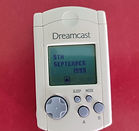
BASH!: For the European launch of the Dreamcast, SEGA took an original approach by sending invitations in the form of a VMU accompanied by a mini-game. The memory card displayed the address and date of the London launch event. The guest who achieved the highest score in BASH! would win a console.
The BASH mini-game



-
VMU Red Bull Event: Elton Bird, who was also behind BASH!, developed an application for an urban race organized by Red Bull through the streets of London. Skaters, BMX riders, and mountain bikers took part. To keep the route a secret, each participant received a VMU before the start indicating the next checkpoint. At each stage, a VMU-to-VMU connection with the zone manager revealed the following destination, all the way to the finish line.
Beyond mini-games, two VMUs could be paired to exchange save files between players. Some studios also took advantage of the LCD screen to display additional information about the ongoing game, helping to reduce the load on the television display.
The Visual Memory Unit remains a symbol of a pioneering attempt to extend gameplay beyond the television screen—a fascinating bridge between home console and portable gaming!
A Concept Born in SEGA’s Labs… or Somewhere Else
From the very conceptualization phase of the Dreamcast, the Japanese research and development (R&D) teams were not just aiming to create a high-performance console. Their ambition was to develop a platform capable of introducing a new way to play. From this vision emerged the VMU and the built-in modem, conceived as natural extensions of the gaming experience. Moreover, SEGA sought to transform its latest console into a multimedia machine, as evidenced by the Dreamcast Zip Drive and the Swatch peripheral, both famous accessories that were ultimately canceled.
Riding the wave of portable electronic toys, such as Tamagotchis, SEGA engineers further developed the idea of a memory card freed from its primary role. Their goal was to create a module capable not only of storing save data but also of displaying information on a small screen and running independent mini-programs.
According to some unconfirmed sources, an accessory never released for the Nintendo 64 called the “Secret Screen”, prototyped by Dane Galden (the inventor of the Game Handler for the NES) for a third-party manufacturer, may have influenced SEGA’s work on the VMU. An issue of Electronic Gaming Monthly, published in September 1997, mentioned on the same page the Black Belt system, the “future” Dreamcast, and this curious add-on designed to be inserted into the N64 controller. After reading this article, engineers at the Blue Hedgehog company reportedly adapted Dane’s concept to create the Visual Memory Unit. This appears to be nothing more than a coincidence, but the similarity between the two concepts is worth mentioning.
The N64 Secret Screen, a neat find

The creation of the VMS posed numerous challenges, balancing compactness, cost control, and versatility. The Dreamcast controller’s design also imposed its own constraints, as the accessory had to fit into one of the two dedicated ports on the controller. These technical requirements, among others, guided SEGA’s engineering teams toward a monochrome LCD screen to reduce power consumption, a streamlined design featuring a directional pad and two buttons, button-cell battery power for portable use, and flash memory reserved for storing save data and mini-programs.
Every decision made around the VMS reflected a consistent desire to balance autonomy, production cost, and user comfort.
The Emergence of the VMU Software Ecosystem: Its SDK and Associated “Memory Card Utility” Tools (Available for Download)
On the software side, SEGA developed a dedicated VMU SDK (Software Development Kit) for both its internal teams and third-party studios. This set of tools allowed developers to create graphics tailored to the VMU’s low-resolution screen, program mini-games and utilities, and manage data exchanges between the Dreamcast and the Visual Memory Unit.
Regularly, game GD-ROMs included VMU applications directly. The console would then transfer them to the VMU’s memory, turning it into a portable extension of the main game.
Among the VMU SDK utilities, one deserves special mention, as it catered to both beginners and experts: the Visual Memory Simulator. It emulates the Dreamcast memory card on a PC, allowing developers to observe the display and behavior of their mini-games or applications without needing to connect a real VMU to a Dreamcast. However, SEGA’s official emulator did not perfectly replicate the speed and behavior of the actual hardware. For this reason, final testing always had to be carried out on a real VMU.
The Visual Memory Simulator, for Real
.png)
To transfer data from the PC development environment to a VMU via a Dreamcast development kit (Katana), developers used the Memory Card Utility (MCU), provided on a confidential red disc. With this tool, they could send a VMU mini-game or application to the memory card. From the MCU menus—reminiscent of those in Super Hang-On—they could also manage VMU files, including copying, deleting, viewing information, and checking available space. Additionally, they tested the icons, comments, and animations that appear in the Dreamcast’s “File Menu”. In short, the Memory Card Utility served as the essential bridge between the developer’s PC and the actual VMU.


.jpg)

About the Download Links
Memory Card Utility (Jan 12, 1999 Dreamcast Version): Surprisingly, the “Single Density” area of this confidential GD-ROM version of the Memory Card Utility hides much more than simple legal notices. It contains several intriguing files, including 0VMUSUTIL.BIN, 0VMUSUTIL.ELF, and 0VMUSUTIL.MAP. Whereas this section of a typical Dreamcast disc usually only holds copyrights or a few PC-accessible bonuses, this version opens a true backdoor into the program’s inner workings. For reverse engineering enthusiasts, these files serve as a secret key, granting access to the “game/program code” through its debugging symbols.
This provides a clearer understanding of the methods developers used to work with the Dreamcast memory card at the beginning of the new millennium.
What the VMU Technical Documentation Reveals (Downloadable Documents)
Behind the VMU, as the general public knows it, lies a far more technical world, rarely accessible outside professional circles in the industry. In addition to downloading the VMU SDKs and the various revisions of the Memory Card Utility, this article invites readers to explore documents spanning several hundred pages, covering the Visual Memory Unit’s architecture, the installation and usage guides for its SDKs, the workings of the MCU, the structure of the Visual Memory Simulator, and many other aspects related to the Dreamcast memory card. Here they are:


The development of the VMU reflects SEGA’s late-1990s philosophy, rooted in innovation and experimentation!
Special thanks to:
-
FX-Man for proof-reading the French text
-
Neil Riddaway for the English correction of the article
The page [Dreamcast SDKs and Development Libraries: Download and Explore] lists more than 12 SDKs or derivatives, primarily for the Dreamcast.
